If you grow a peach tree, you already know how rewarding those juicy, sun-warmed fruits can be. But many home gardeners unknowingly cut their harvest in half simply because they don’t prune correctly—or at all. With a few simple techniques, you can reshape your peach tree so it produces more, bigger, and sweeter fruit without adding more work to your routine.
Below you’ll learn the practical, easy-to-follow pruning secrets that can transform your peach tree in just a couple of seasons.
Why pruning is non‑negotiable for a productive peach tree
Peach trees are different from many other fruit trees: they bear fruit on one-year-old wood—the shoots that grew last season. That means regular pruning doesn’t just tidy the tree, it directly controls how much fruit you get.
Smart pruning of a peach tree will:
- Increase sunlight and airflow inside the canopy
- Encourage strong new shoots for next year’s fruit
- Reduce disease problems like leaf curl and brown rot
- Improve fruit size, sweetness, and color
- Keep the tree at a manageable height for picking
Skipping pruning may sound like “less effort,” but the result is usually small, tasteless fruit, diseased wood, and a tangled tree that’s hard to manage.
The ideal shape: An open-center peach tree
The easiest and most productive way to train a peach tree is with an open-center (also called open-vase) shape. Think of it as a bowl or wineglass:
- No central leader (no tall middle trunk rising through the canopy)
- 3–5 main branches (called scaffolds) radiating out like spokes
- An open middle that lets sunlight reach every branch
This shape gives you two huge advantages:
- Maximum light: Peaches need sun on their fruiting wood. An open center exposes every productive shoot.
- Easy access: You can prune, thin, and harvest without ladders or wrestling through dense branches.
If your peach tree is still young, shaping it early saves years of correction later. If it’s older and overgrown, you can still gradually move it toward a more open, productive form.
The best time to prune a peach tree
Timing matters more for peach trees than for many other types of fruit trees.
-
Main pruning: Late winter to very early spring
Prune after the hardest freezes but before buds fully open. This is late winter or early spring in most regions.- Cold damage is easier to assess.
- Fresh cuts heal quickly as the tree wakes up.
-
Avoid deep dormant pruning in mid-winter in very cold areas
Large cuts during deep cold can stress the tree. -
Summer touch-ups: Optional, light pruning
In mid- to late summer, you can:- Remove watersprouts (vertical whips)
- Thin out overly dense areas
- Head back overly vigorous shoots that ruin the shape
For beginners, focusing on one solid late-winter pruning each year is enough to dramatically improve fruiting.
Step-by-step: Pruning a young peach tree for maximum future fruit
If your peach tree is in its first 3–4 years, you’re mostly building structure. Here’s the simple plan.
Year 1: Choose your main branches
In the first dormant season after planting:
-
Select 3–5 scaffold branches
- Evenly spaced around the trunk
- Angles of about 45–60° from the trunk (not straight up, not drooping)
- Starting 18–24 inches (45–60 cm) above the ground
-
Remove competing branches
- Cut off any vertical leader that tries to be the main top
- Remove any branches crossing through the middle
-
Head back the chosen scaffolds
- Shorten them by about one-third to one-half
- This encourages side branches that will later carry fruit
Years 2–3: Build out the “bowl”
Each late winter:
-
Keep the center open
- Remove any vertical branches growing toward the middle
- Don’t allow a central leader to reform
-
Keep scaffolds balanced
- Shorten overly vigorous branches so no one branch dominates
- Remove any branches that cross or rub
-
Encourage strong new shoots
- Light heading cuts on ends of branches help create more side shoots
- Those 1-year-old side shoots are your future peach producers
By the end of year 3, your peach tree should look like a low, spreading, open bowl with several strong arms and lots of young shoots.
Pruning a mature peach tree: The real “double your fruit” move
Once your peach tree is established (4+ years old), your goal shifts to renewal: constantly replacing older, tired wood with fresh, productive shoots.
Here’s the core secret:
A mature peach tree should be pruned each year so that much of its fruit comes from vigorous one-year-old shoots.
In late winter, work through this sequence:
1. Start with dead, diseased, and damaged wood
- Cut out:
- Dead branches (brown, brittle)
- Black, cankered, or oozing wood
- Broken or storm-damaged limbs
Cut back to healthy wood or to the branch collar (the slight swelling where a branch joins a larger limb).
2. Open up the center and thin overcrowding
- Remove:
- Any branch growing into the middle of the tree
- Branches that cross and rub
- Branches growing straight up (watersprouts) or straight down
Aim for spacing that lets light reach every fruiting shoot. If two branches are competing for the same space, keep the better-placed, younger, or stronger one.
3. Renew fruiting wood
Look for older, gray, stiff branches with little new growth. These are less productive. Then:
- Cut back older branches to a younger outward-facing shoot
- Encourage strong, 12–18 inch (30–45 cm) one-year-old shoots along the main scaffolds
- Remove very weak, thin twigs—they’ll rarely carry quality fruit
Over time, you want a constant flow of new shoots replacing old wood. This channeled energy makes each remaining fruit bigger and better.
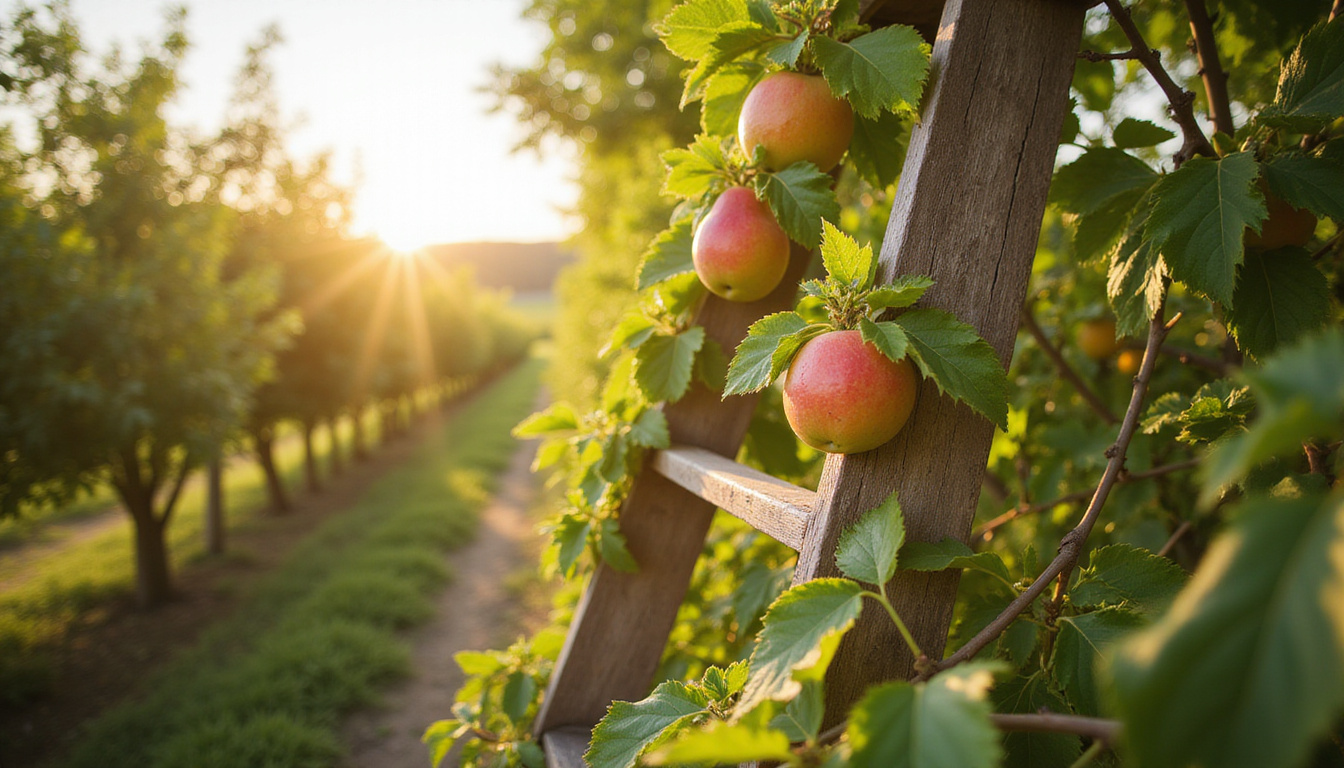
4. Control height and spread
A good target is a peach tree about 7–9 feet (2–2.7 m) tall—reachable from the ground or a short step-stool.
- Head back tall upper branches to outward-growing side shoots
- Remove long, whippy branches that arch too far from the tree’s shape
- Keep the top slightly narrower than the base to let light in (a “Christmas tree” profile from the side, but open inside)
Done consistently, this opens the canopy, keeps fruit within easy reach, and increases both yield and quality.
The fruit-thinning secret: Why less fruit = more harvest
Even with perfect pruning, a peach tree will often set more fruit than it can support. Without thinning, you get:
- Small, bland peaches
- Branches that break under weight
- Stressed trees that fruit poorly the next year
Right after natural “June drop” (when the tree sheds some fruit on its own), go back and thin:
- Leave fruit about 6–8 inches (15–20 cm) apart on the branch
- Remove damaged, misshapen, or crowded peaches first
- Don’t be afraid to remove half or more of the baby fruit
This feels harsh, but it’s one of the highest-leverage “no extra effort” moves: the tree’s total energy stays the same, but is divided among fewer peaches—meaning bigger, juicier fruit and less branch damage.
Tools and simple pruning rules for peach trees
You don’t need a lot of equipment, just reliable basics:
- Bypass hand pruners – for shoots up to ~¾ inch (2 cm)
- Loppers – for limbs up to about 1½ inches (4 cm)
- Pruning saw – for larger branches
- Gloves and safety glasses
Keep tools sharp and clean. Sterilizing blades between trees (or between diseased and healthy branches) with alcohol or a bleach solution helps reduce disease spread (source: University of California Agriculture & Natural Resources).
A few easy-to-remember rules:
- Cut just above outward-facing buds or side branches.
- Don’t leave stubs—cut back to the branch collar.
- Remove no more than about one-third of the total wood in a single year on an older, neglected tree; reclaim it in stages.
Rescuing a neglected or overgrown peach tree
If you’ve inherited a tall, dense peach tree that’s never been pruned, trying to fix everything in one year can shock it. Instead:
Year 1
- Remove dead, diseased, and clearly crossing branches.
- Start opening the center by removing 1–3 of the worst interior limbs.
- Reduce height moderately, bringing the top down by 2–4 feet (60–120 cm).
Year 2
- Further open the center, choosing 3–5 permanent scaffolds.
- Continue to shorten tall, unproductive branches to younger side shoots.
- Thin out crowded areas to let sun hit developing shoots.
Year 3
- Refine into a true open-center form.
- Focus on renewing fruiting wood and balancing scaffold strength.
By moving gradually, you’ll improve fruit production every year while avoiding severe stress or sunscald from suddenly exposing shaded branches.
Common peach tree pruning mistakes to avoid
To truly “double fruit without extra effort,” avoid these frequent errors:
- Not pruning at all – leads to small, poor-quality peaches and disease.
- Leaving a tall central leader – creates shade and hard-to-reach fruit.
- Over-thinning structure, under-thinning fruit – you want plenty of 1-year shoots, but fewer actual peaches per branch.
- Making flush cuts or leaving stubs – both slow healing and invite disease.
- Pruning too early in very cold climates – can expose tender tissue to freeze damage.
Sticking to the simple principles—open center, renew one-year wood, control height, and thin fruit—prevents almost all of these problems.
FAQ: Peach tree pruning and care
How do you prune a peach tree for more fruit?
Prune in late winter, removing dead and crossing branches and opening the center of the tree. Focus on creating an open-center shape with 3–5 main branches and plenty of vigorous one-year-old side shoots. Then, in early summer, thin the baby peaches so they’re 6–8 inches apart. This combination of pruning and thinning directs more energy into each remaining fruit, increasing both yield and quality.
When is the best time to trim a peach tree?
The best time to trim a peach tree is late winter to early spring, after the coldest weather has passed but before buds fully open. This timing helps cuts heal quickly and lets you clearly see the branching structure. Light summer pruning can be used to remove watersprouts and overly dense growth, but heavy structural cuts should be saved for late winter.
Can you hard prune an old peach tree?
You can rejuvenate an old peach tree, but avoid extreme hard pruning in a single year. Instead, spread the work over 2–3 seasons. Each year, remove dead and diseased wood, gradually open the center, and reduce height by cutting back to younger side branches. This staged approach revitalizes the tree and encourages new fruiting wood without causing severe stress.
Properly pruning a peach tree isn’t about working harder; it’s about working smarter. Once you understand that peaches are produced on one-year-old shoots, everything clicks: your job each year is simply to open the canopy, renew young wood, and thin fruit so the tree can pour its energy into fewer, better peaches.
If you’re ready to turn a crowded, underperforming peach tree into a compact, high-yielding producer, pick a late-winter weekend, sharpen your tools, and start shaping. Apply the steps above to just one tree this season, observe the difference in fruit size and quality, and then roll the same approach out to every peach tree in your yard. Your future harvests—and everyone you share them with—will thank you.
Throughout history, many plants and herbs have been associated with luck, protection, and prosperity. To explore their deeper spiritual, psychological, and scientific significance, visit SpiritualMindScience.com.