The Paschal candle is one of the richest and most beautiful symbols in the Christian liturgical year. Seen prominently during the Easter Vigil and throughout the Easter season, this large, decorated candle tells the story of Christ’s death and resurrection in wax, flame, and ritual. Whether you’re a catechist, liturgy planner, artist, or simply curious, understanding its symbolism and exploring creative decoration ideas can deepen both faith and appreciation.
What Is the Paschal Candle?
In Christian tradition—especially in Roman Catholic, Anglican, Lutheran, and some other liturgical churches—the Paschal candle is a large, white candle blessed and lit during the Easter Vigil. It remains a central symbol throughout the Easter season and is used at baptisms, funerals, and other special liturgies during the year.
Key characteristics of the Paschal candle:
- It is usually tall and prominent, often placed in a large candlestick near the ambo or altar.
- It is marked with the current year, a cross, and the Greek letters Alpha (Α) and Omega (Ω).
- It is first lit from the new fire at the beginning of the Easter Vigil.
“Paschal” comes from “Pascha,” the Latin and Greek term for Passover and, by extension, Easter. Thus, the candle is directly connected to Christ’s Passover from death to life.
The Deep Symbolism of the Paschal Candle
Every mark on the Paschal candle is intentional and rich in meaning. Understanding these traditional elements helps you see it not merely as decoration but as a “visual homily” on the Resurrection.
1. The Flame: Christ, Light of the World
The flame of the Paschal candle symbolizes:
- Christ as the Light of the World (John 8:12).
- The victory of light over the darkness of sin and death.
- The presence of the risen Christ in the gathered assembly.
At the Easter Vigil, the church begins in darkness. The fire is kindled outside, the candle is lit, and the priest or deacon proclaims, “The Light of Christ.” As the flame spreads from the Paschal candle to small candles held by the congregation, it visually proclaims the spread of Christ’s light into every heart.
2. The Wax: Christ’s Body Offered in Love
Traditionally, the candle is made of beeswax, itself symbolic:
- Beeswax has been seen as a symbol of purity, especially in early Christian writers.
- The wax “consumed” by the flame evokes Christ’s body, given and consumed in love.
- The candle slowly diminishing over time recalls Christ’s self-giving sacrifice.
Some traditions explicitly compare the burning candle to Christ offering Himself for the life of the world.
3. The Cross, Alpha & Omega, and the Year
Most Paschal candles feature a specific, centuries-old design:
- The Cross: Placed prominently at the center, it is the sign of Christ’s redemptive death.
- Alpha and Omega: The first and last letters of the Greek alphabet (Α and Ω) symbolize Christ as the beginning and the end of all things (Revelation 1:8).
- The Current Year: Written around the cross, reminding us that Christ’s saving work is not past history but present and active “today.”
During the blessing, the minister often traces these signs while proclaiming Christ as Lord of time and history.
4. The Five Grains of Incense
Many Paschal candles include five grains of incense or wax “nails” inserted into the candle in the form of a cross. These symbolize:
- The five wounds of Christ (hands, feet, and side).
- The fragrant offering of Christ’s sacrifice to the Father.
- The union of suffering and glory in the risen Christ.
The incense grains are often blessed and inserted with a short prayer, emphasizing the mystery of the Passion and Resurrection.
When and How the Paschal Candle Is Used
The Paschal candle has a defined liturgical “life.” Knowing when and how it is used helps both worshippers and planners appreciate its significance.
The Easter Vigil: Birth of the New Fire
The central moment for the Paschal candle is the Easter Vigil:
- Blessing of the Fire – Outside or at the church entrance, a new fire is kindled.
- Preparation of the Candle – The cross, year, Alpha, Omega, and incense may be traced or inserted with prayers.
- Lighting the Candle – The Paschal candle is lit from the new fire.
- Procession into the Dark Church – The minister carries the candle, stopping three times to proclaim “The Light of Christ,” to which the people respond, “Thanks be to God.”
- Exsultet (Easter Proclamation) – Once placed in its stand, the candle is honored as the deacon or cantor sings the Exsultet, praising the candle, the night, and the Resurrection.
From that moment, the candle becomes a focal point of the Easter celebration.
During the Easter Season
Throughout the Easter season (from Easter Sunday through Pentecost):
- The Paschal candle is placed in a prominent location, often near the ambo or altar.
- It is lit for every Mass and liturgical celebration as a sign of the risen Christ present among His people.
- The burning candle visually marks the “fifty days of Easter,” a continuous feast of Resurrection joy.
Baptisms and Funerals
Even after Pentecost, the Paschal candle continues to be used at sacred moments:
-
Baptisms
- The Paschal candle is lit.
- A small baptismal candle is then lit from it and given to the newly baptized (or their godparents) with words such as “Receive the light of Christ.”
- This symbolizes the sharing of Christ’s light and life with the new Christian.
-
Funerals
- The Paschal candle is often placed near the casket or urn.
- It links the deceased’s life and death to Christ’s own death and Resurrection.
- The same light that welcomed them in baptism now shines as a sign of hope in eternal life.
Liturgical documents emphasize this baptismal connection between the Paschal candle, Christian initiation, and Christian death (source: USCCB – Built of Living Stones).
Traditional Designs and Variations
While every Paschal candle should clearly display the core symbols, there is also room for meaningful variation.
Common traditional elements:
- Large central cross
- Alpha and Omega above and below the cross
- The current year at the four corners of the cross
- Five grains of incense/wax nails
Variations may include:
- Depictions of the Risen Christ
- Lamb of God or Paschal Lamb with flag
- Scenes or symbols from the year’s lectionary cycle
- Local saints or patronal symbols integrated respectfully
These variations can reflect the community’s spirituality while remaining faithful to the candle’s central meaning.
Creative Decoration Ideas for a Paschal Candle
For parishes, religious communities, or artists tasked with designing a Paschal candle, creativity can serve the liturgy. The goal is not gimmickry but beauty that deepens faith and understanding.
Here are some thoughtful decoration ideas:
1. Use Symbolic Colors and Motifs
While the Paschal candle itself is normally white or off-white, decorations can incorporate color:
- Gold – For glory, divinity, and kingship.
- Red – For the Passion and the Holy Spirit.
- Blue – For Mary and hope.
- Green – For new life and growth.
Motifs you might incorporate:
- Wheat and grapes (Eucharist, new life)
- Vine and branches (union with Christ)
- Water waves (baptism, Red Sea, Jordan)
- Flames or rays (Holy Spirit, Resurrection light)
2. Incorporate Scripture Verses
Short, powerful scripture phrases can be carefully painted or engraved:
- “I am the Light of the World” (John 8:12)
- “He is Risen” (Matthew 28:6)
- “The Light Shines in the Darkness” (John 1:5)
Keep text minimal and legible from a distance; the main focus should remain on the core symbols.
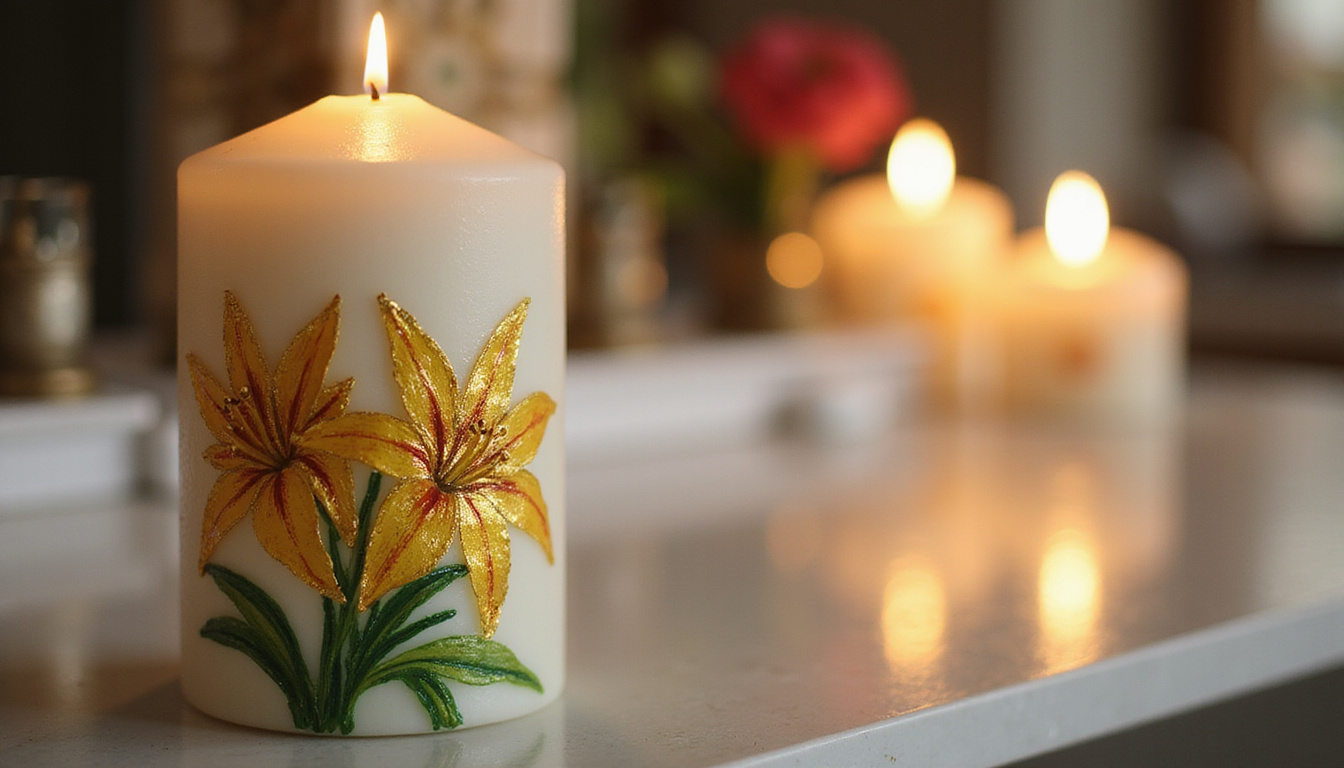
3. Highlight the Cross and Wounds
Make the cross and five wounds visually striking:
- Use contrasting wax or paint for the cross.
- Create raised wax “nails” for the wounds, perhaps with small red stones or colored wax to symbolize blood and glory.
- Surround the cross with subtle rays or a halo, emphasizing Resurrection rather than only suffering.
4. Use Beeswax Reliefs or Appliqués
If working with real beeswax:
- Mold small reliefs (e.g., lamb, dove, chi-rho) and apply them to the candle.
- Carve shallow designs into the wax and fill with colored wax or gilding.
- Add a textured border around the main symbols to frame the design without overwhelming it.
5. Reflect the Liturgical Year Theme
Some parishes choose to echo the readings or themes of the current liturgical cycle:
- Year A – Use symbols of water and new birth (e.g., Samaritan woman, living water).
- Year B – Emphasize the Eucharist and Bread of Life imagery.
- Year C – Highlight mercy, joy, and the Good Shepherd.
This can create a strong connection between the candle and the year’s proclamation of the Word.
Practical Tips for Designing and Handling a Paschal Candle
When planning or decorating a Paschal candle, consider both beauty and practicality.
Design and preparation tips:
- Choose high-quality, primarily beeswax candles if possible.
- Sketch your design at scale before working on the actual candle.
- Use wax sheets, wax pens, or liturgical-grade paints designed to adhere to wax.
- Keep decoration no more than about halfway down the candle to prevent damage as it burns.
Handling and storage tips:
- Store in a cool, dry place away from direct sunlight.
- Use a stable, well-fitted stand to prevent tipping.
- Trim the wick as needed to prevent excessive dripping or smoking.
- After the Easter season, store the candle carefully; in some communities, remnants are melted for devotional candles or preserved as a keepsake.
Why the Paschal Candle Still Matters Today
In a world full of digital screens and constant artificial light, the simple image of a single, living flame has powerful impact. The Paschal candle:
- Visually proclaims the Resurrection in every liturgy where it stands.
- Connects baptism, daily Christian life, and death into one continuous story in Christ.
- Draws people—especially children and newcomers—into the mystery through beauty and symbolism.
- Serves as a reminder that the light of Christ is not abstract but concrete, burning in the midst of the community.
For many, the moment when the dark church slowly fills with candlelight at the Easter Vigil is one of the most moving experiences of the entire year.
FAQ About Paschal Candles
What is a Paschal candle used for in church?
A Paschal candle is used primarily during the Easter Vigil, throughout the Easter season, and at baptisms and funerals. It symbolizes the risen Christ, the Light of the World, and is lit at significant moments to show His presence and the hope of Resurrection.
How long is the Easter candle (Paschal candle) used?
The Easter or Paschal candle is lit at all liturgical celebrations during the Easter season (from the Easter Vigil through Pentecost). After that, it is used for baptisms and funerals throughout the year, until it is replaced by a new Paschal candle at the next Easter Vigil.
Can a Paschal candle be reused from year to year?
Liturgical norms in most traditions call for a new Paschal candle each year, marked with the current year to signify Christ’s presence “today.” While a church might reuse an older Paschal candle in non-liturgical settings, the principal Paschal candle for worship should typically be newly blessed each Easter.
Bring the Light of the Paschal Candle to Life in Your Community
The Paschal candle is far more than an annual purchase or a piece of liturgical décor. It is a living symbol of the risen Christ, the center of the Easter Vigil, and a companion at the most important moments of Christian life—baptism, Eucharist, and funeral rites. By understanding its rich symbolism, using it prayerfully in the liturgy, and investing care and creativity in its design, you can help your parish or community encounter the mystery of Easter more deeply.
If you’re responsible for liturgy, catechesis, or church art, consider planning now: reflect on the coming year’s themes, sketch a meaningful design, and invite others into the process. Let your next Paschal candle become a true work of prayer and beauty—so that when its flame is lifted high and the words “The Light of Christ” resound, hearts are ready to receive that light and carry it into the world.
Sacred objects often carry deep cultural and spiritual meaning. Learn how these symbols relate to history, spirituality, and the human mind by exploring more articles at SpiritualMindScience.com.