Mjolnir is one of the most iconic mythical weapons in human culture—a hammer that can summon storms, topple giants, and return faithfully to its master’s hand. Whether you know Mjolnir from ancient Norse mythology or from Marvel’s Thor movies and comics, the hammer sits at the intersection of religion, folklore, and modern pop culture. This guide breaks down its hidden history, symbolic meaning, and legendary powers, and explains how a medieval mythological tool became a global superhero emblem.
The Origins of Mjolnir in Norse Mythology
Long before movie screens turned it into a glowing, high-tech weapon, Mjolnir belonged to the Norse god Thor, protector of gods and humans. Our main historical sources are Old Norse texts like the Poetic Edda and Prose Edda, preserved in medieval Iceland (source: Encyclopaedia Britannica).
The Dwarven Craftsmen
According to the myths, Mjolnir was forged by the dwarven brothers Brokkr and Sindri (sometimes called Eitri), legendary smiths of the gods. Loki, the trickster god, triggered this event when he cut off the hair of Thor’s wife Sif. To escape Thor’s wrath, Loki promised replacement treasures, goading multiple dwarven craftsmen into a contest.
From this contest came three great treasures from Brokkr and Sindri:
- Gullinbursti – a golden boar with radiant bristles
- Draupnir – Odin’s golden arm ring that multiplies itself
- Mjolnir – the hammer that would define Thor’s power
Loki attempted to sabotage the forging by biting Brokkr in fly form, causing the hammer’s handle to be made shorter than intended. Ironically, this “flaw” gave Mjolnir its distinctive one-handed, war-hammer shape—and made it ideal to wear on a belt or wield in battle.
What Does “Mjolnir” Mean?
The name “Mjolnir” likely comes from Old Norse roots with several related meanings:
- “Crusher” or “grinder” – referring to the hammer’s destructive power
- “Lightning” – connecting the weapon to thunder and storms
- Linked to words like the Russian molniya (lightning) and Old Church Slavonic mlunuji (to smash)
All these associations fit Thor as a thunder god and sky deity. In myth, when Thor threw Mjolnir, it brought thunder, lightning, and catastrophic force upon his enemies, especially frost giants.
Mjolnir as the Ultimate Weapon of the Gods
In the mythology, Mjolnir is far more than a heavy hammer. It’s described as the most fearsome weapon in existence, feared by giants and monsters across the Nine Worlds.
Core Mythic Powers of Mjolnir
Across Norse legends, the hammer consistently shows several abilities:
- Unerring Aim – Thor could throw it at any target and it would hit with perfect precision.
- Returning Throw – After being thrown, Mjolnir would always fly back into Thor’s hand.
- Tremendous Impact – A single blow could crush mountains, giants, and monstrous beasts.
- Storm Connection – Thunder and lightning followed the hammer’s strikes, tying Thor to the power of storms.
Some later interpretations also emphasize:
- Blessing and Consecration – Mjolnir could bless marriages, births, and funerals, symbolizing protection and sacred authority.
- Protection of the Cosmos – Thor and Mjolnir guarded Asgard (realm of the gods) and Midgard (world of humans) from chaos and invasion.
Thor’s Battle Gear: Mjolnir and Its Accessories
To fully control Mjolnir’s destructive power, Thor relied on special equipment. The myths mention:
- Járngreipr (Iron Gauntlets) – Magical gloves that enabled Thor to grasp and wield Mjolnir properly.
- Megingjörð (Belt of Strength) – A belt that doubled Thor’s already immense strength whenever he wore it.
With hammer, belt, and gauntlets combined, Thor was not just a warrior; he was the ultimate defender of the gods, capable of taking on world-serpents and armies of giants.
Mjolnir in Famous Norse Myths
Mjolnir appears in many stories, but a few tales showcase its importance both as a weapon and as a symbol.
The Theft of Mjolnir
In the poem Þrymskviða (“The Lay of Thrym”), the giant Thrym steals Mjolnir and demands the goddess Freyja as his bride in exchange for its return. To retrieve the hammer, the gods devise a clever plan:
- Thor disguises himself as Freyja, wearing a bridal dress and veil.
- Loki acts as his maidservant.
- At the wedding feast in Jötunheim, Thor (in disguise) eats and drinks so much that Thrym becomes suspicious.
- To “bless” the marriage, Mjolnir is brought out and placed on Thor’s lap—right where he needs it.
- Thor seizes the hammer and slaughters Thrym and the giants, reclaiming his weapon.
This myth highlights how central Mjolnir is: without it, even the gods feel vulnerable.
Battling the Midgard Serpent
In myths about Ragnarök, the end of the world, Thor confronts Jörmungandr, the serpent encircling Midgard. Armed with Mjolnir:
- Thor destroys the world-serpent with a mighty blow.
- But he only walks nine steps before collapsing, killed by the serpent’s venom.
Even at the world’s end, Mjolnir is critical to the cosmic balance, allowing Thor to kill a force of chaos, even at the cost of his own life.
Symbolism: What Mjolnir Meant to the Norse People
For the ancient Norse, Mjolnir was not merely a weapon of folklore; it was a powerful symbol woven into daily life and religious practice.
Protector of Order and Community
Thor was a guardian figure, and his hammer embodied:
- Protection from Chaos – Giants, monsters, and forces of nature symbolized threats to order.
- Defense of the Everyday – Farmers, seafarers, and warriors all invoked Thor for safety.
Wearing a Mjolnir pendant was a way of aligning oneself with stability, strength, and divine protection.
A Counter-Symbol to the Christian Cross
Archaeological finds from the Viking Age show that as Christianity spread through Scandinavia, people increasingly wore Mjolnir amulets. Scholars interpret this in several ways:
- As a religious identity marker for those maintaining Norse pagan beliefs
- As a cultural symbol of resistance to foreign influence
- As a parallel to the cross, with both symbols representing blessing, protection, and sacred power
Mjolnir pendants have been discovered in graves, hoards, and settlements across Scandinavia and beyond, testifying to its importance in personal belief and cultural identity.
How Mjolnir Works in Marvel Comics and Movies
Most modern audiences know Mjolnir from Marvel’s Thor. While inspired by Norse myth, Marvel’s version reimagines the hammer with new rules and story functions.
Enchantment of Worthiness
In the comics and the Marvel Cinematic Universe (MCU), Odin places a spell on Mjolnir:
“Whosoever holds this hammer, if he be worthy, shall possess the power of Thor.”
Key features of Marvel’s Mjolnir include:
- Worthiness Requirement – Only those who are morally worthy can lift it.
- Channeling Divine Energy – It focuses and amplifies Thor’s godly powers.
- Flight and Return – Thrown with enough force, it effectively enables flight as Thor holds on to the handle.
- Dimensional Travel – It can open portals or move across realms in certain stories.
This “worthiness” rule does not exist in the original Norse myths but has become central to modern interpretations.
Who Has Lifted Marvel’s Mjolnir?
Over decades of comics and films, a handful of characters have proved worthy enough to wield the hammer, including:
- Captain America (Steve Rogers)
- Beta Ray Bill
- Jane Foster (as The Mighty Thor)
- Vision (MCU)
- Odin and a few other deities
Each instance reinforces Mjolnir as a test of character, not just strength—turning it into a moral symbol as much as a weapon.
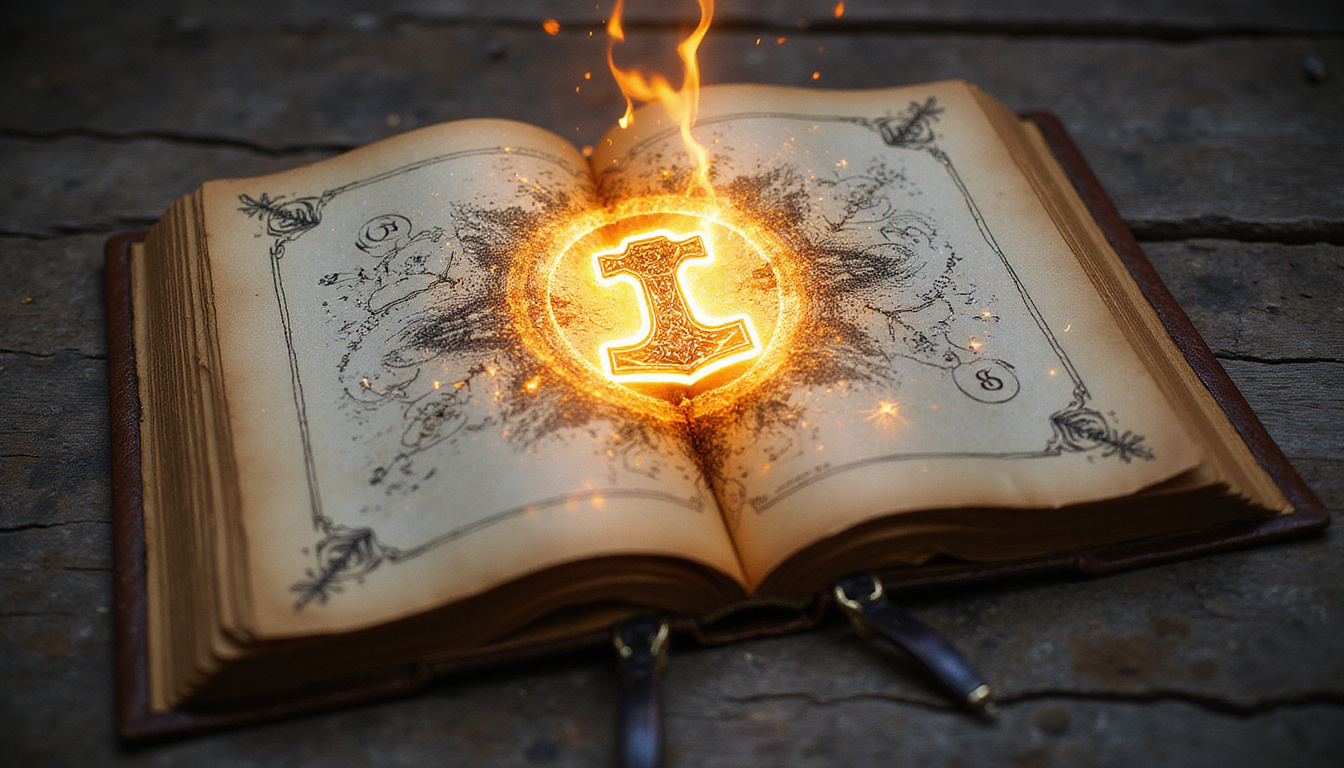
Comparing Mythic and Modern Mjolnir
There’s overlap between the original myth and modern fiction, but key differences stand out.
Shared Elements
- Weapon of Thor, god of thunder
- Returns to his hand after being thrown
- Associated with storms and tremendous impact
- Feared by powerful enemies
Mythic-Specific Elements
- Forged by dwarfs with a shortened handle “flaw”
- No “worthiness” rule—Thor simply owns and wields it
- Used for blessing marriages, births, and oaths
- Deeply tied to real-world religious practice and symbolism
Marvel-Specific Elements
- Magic inscription and moral worthiness enchantment
- Often indestructible (until particular plot events)
- Serves as a narrative test of heroism and virtue
- Linked to advanced Asgardian “technology” in the MCU
Understanding these differences helps separate the cultural roots of Mjolnir from its modern, entertainment-focused reinventions.
Why Mjolnir Still Captivates Us Today
Mjolnir endures because it combines simple visual design with immense layered meaning.
- Iconic Shape – The short-handled hammer silhouette is instantly recognizable.
- Mythic Depth – It carries centuries of story, ritual, and belief.
- Moral Dimension – Modern versions tie Mjolnir to worthiness and integrity.
- Power Fantasy – The idea of wielding thunder and lightning in one’s hand is perennially appealing.
- Cultural Bridge – It connects ancient Scandinavian culture with today’s global pop culture.
As a result, Mjolnir appears in films, games, jewelry, tattoos, and literature, continuing to evolve while retaining its mythic core.
FAQ: Common Questions About Mjolnir
1. What is Mjolnir and what does it represent?
Mjolnir is the hammer of the Norse god Thor, originally described in medieval Scandinavian mythology. It represents divine protection, strength, and the power to maintain order against chaotic forces like giants and monsters. In everyday Viking life, Mjolnir pendants symbolized faith, cultural identity, and the blessing of the gods.
2. Could anyone wield Mjolnir in Norse myth?
In the original myths, Mjolnir belongs exclusively to Thor. There is no “worthiness enchantment” like in Marvel’s version; the restriction is ownership and sheer power. Only in rare comic or film adaptations do we see other characters lifting or using Mjolnir, and that’s based on modern storytelling, not the ancient sources.
3. Is Mjolnir real, and are there real Mjolnir artifacts?
The weapon itself is mythological, but archaeologists have found many Mjolnir-shaped amulets across Scandinavia and regions influenced by Norse culture. These small hammer pendants were worn as religious symbols, much like crosses or other sacred emblems, showing that Mjolnir had a very real presence in Viking Age belief and identity.
Harness the Legacy of Mjolnir Today
Mjolnir began as the thunder-god’s hammer in a harsh northern world of storms, sea voyages, and sacred oaths. Over centuries, it has transformed into a global icon of strength, protection, and moral worthiness. Whether you connect with the historical Norse Mjolnir or its modern Marvel incarnation, exploring its stories opens a door into mythology, archaeology, and the values that heroes stand for.
If Mjolnir’s legacy inspires you, go deeper: read the Eddas, explore museum collections, or seek out quality replicas and jewelry that reflect its authentic designs. Let the hammer’s enduring symbolism remind you to stand firm, protect what matters, and wield your own power with wisdom and integrity.
Explore the Science Behind Spirituality
This guide explored the meaning and history of good luck symbols. To discover the psychology, consciousness, and scientific perspectives behind spiritual beliefs, visit SpiritualMindScience.com.