From Paleolithic cave walls to contemporary brand logos, faunal symbolism has shaped how humans understand the world and themselves. Animals appear in myths, religions, flags, tattoos, literature, and films, carrying layers of meaning that go far beyond biology. By decoding these animal meanings across myth, art, and culture, we uncover a shared symbolic language that spans continents and centuries.
This guide explores where faunal symbolism comes from, how it varies around the world, and what it reveals about human fears, hopes, and values.
What is faunal symbolism?
Faunal symbolism is the use of animals to represent ideas, qualities, deities, social roles, or cosmic forces. A creature can symbolize:
- Personal traits (a fox as cunning)
- Moral values (a lamb as innocence)
- Social status or power (a lion as royal authority)
- Spiritual truths (a snake as rebirth or temptation)
- Natural forces (a raven as a messenger between worlds)
These meanings are rarely random. They grow from:
- Observed animal behavior (wolves hunting in packs → loyalty or danger)
- Ecological role (bees pollinating → productivity, cooperation)
- Cultural experience (horses revolutionizing transport → freedom and warfare)
Faunal symbolism is both universal and deeply local: certain themes repeat globally, but each culture inflects them differently.
Ancient roots: animals in early myth and religion
Prehistoric and indigenous foundations
The earliest surviving art—like the animals in France’s Lascaux Cave—suggests that humans spiritually invested animals with significance tens of thousands of years ago. Many scholars think these images are connected to:
- Hunting magic or rituals
- Clan or totem identities
- Early cosmologies linking animals to spirits or gods
In many Indigenous traditions, faunal symbolism remains central. For example:
- Plains tribes of North America: Bison symbolize sustenance and sacred reciprocity, as entire ways of life revolved around respecting and using every part of the animal.
- Australian Aboriginal cultures: Kangaroo, emu, and other animals appear as ancestral beings in Dreamtime stories, shaping the land, laws, and kinship patterns.
- Pacific Northwest peoples: Raven symbolizes both trickster and creator, bringing light to the world but also causing chaos.
These traditions show that animals were never mere “decorations”—they were kin, teachers, and cosmic actors.
Animal gods and divine messengers
In early complex civilizations, faunal symbolism became embedded in religion:
-
Ancient Egypt:
- Horus (falcon-headed) → kingship, sky, and protection.
- Anubis (jackal-headed) → embalming and the journey of the dead.
- Bastet (cat-headed) → home, fertility, and later, joy and music.
-
Ancient Greece and Rome:
- Athena’s owl → wisdom and clear sight.
- Zeus’s eagle → sovereign power and storm.
- Dionysus’s panther → ecstasy and wildness.
-
Hindu traditions:
- Ganesha’s mouse/rat → penetration of obstacles and the subtle mind.
- Vishnu’s eagle Garuda → strength, speed, and the overcoming of evil.
Here, animals don’t just symbolize gods—they are fused with them. By reading the animal associations, you decode the deity’s character.
Shared patterns: recurring animal meanings worldwide
While every culture is unique, faunal symbolism features notable cross-cultural patterns.
Predators: power, danger, protection
Predators naturally carry intense symbolic weight:
- Lions: Often royalty, courage, sovereignty (from African cultures to British heraldry). Yet for early Christians, lions could also symbolize both Christ (strength) and Satan (devouring danger).
- Wolves: Ambivalent meaning.
- In European folklore: threat, greed, and the dangers beyond the village.
- Among some Native American tribes: loyalty, family, and teacher of survival.
- Eagles and hawks: Vision, majesty, connection to the sky realm; used in imperial emblems from Rome to the United States.
Predators remind us that power is double-edged: it can protect or destroy.
Herd animals: life, sacrifice, and community
Creatures tied to agriculture and domestication often symbolize:
- Cattle and oxen: Labor, wealth, and cosmic strength (e.g., the Apis bull in Egypt, the bull in Mesopotamian religion).
- Sheep and lambs: Innocence, sacrifice, and community; the “lamb of God” in Christian symbolism, and sacrificial lambs in many ritual systems.
- Pigs: Abundance and pleasure—but also greed and impurity in cultures where pork is taboo.
Herd animals reveal how dependent human life has been on domesticated creatures, and how that dependence shapes spiritual ideas of debt, sacrifice, and gratitude.
Birds: messengers between worlds
Because they fly, birds easily become symbols of transition and communication:
- Doves: Peace, spirit, and divine presence, especially in Christianity.
- Crows and ravens:
- In Norse myth, Odin’s ravens Huginn and Muninn represent thought and memory.
- In many Western traditions, crows/ravens symbolize bad omens or death.
- In some Indigenous and Asian traditions, they’re tricksters or wise guides.
- Owls: Wisdom and insight for some; death and ill omen for others.
Bird symbolism often splits into “light” (eagle, dove) and “shadow” (raven, vulture), mapping human hopes and fears onto the sky.
Faunal symbolism by culture and tradition
East Asia: harmony, balance, and auspicious animals
In Chinese, Japanese, Korean, and related traditions, faunal symbolism is woven into art, astrology, and everyday life.
- Dragon: Unlike the evil dragons of many European myths, East Asian dragons are benevolent, signifying rain, prosperity, imperial authority, and cosmic balance.
- Phoenix (Fenghuang in China): Virtue, renewal, the empress, and harmonious reign.
- Tiger: Bravery, military power, and sometimes protection against evil spirits.
- Chinese zodiac animals (rat, ox, tiger, rabbit, dragon, snake, horse, goat, monkey, rooster, dog, pig) represent personality archetypes and cycles of time.
These symbols are often used consciously to attract fortune, ward off misfortune, or express ideals like balance and longevity.
Abrahamic traditions: moral lessons and spiritual metaphors
In Judaism, Christianity, and Islam, animals frequently act as moral mirrors or metaphors for the soul:
- The serpent in Genesis: temptation, knowledge, and disobedience.
- The lamb in Christian theology: innocence, sacrifice, and salvation.
- The dove: divine Spirit, peace, and God’s favor.
- The dog: faithfulness in some contexts; impurity in others, depending on period and tradition.
Parables and stories use animals to embody virtues (like the industrious ant) or vices (like the gluttonous pig), turning faunal symbolism into ethical teaching tools.
African and Afro-diasporic traditions: tricksters, ancestors, protectors
Across the African continent and the African diaspora, animals often connect human communities to ancestral and spiritual realms:
- Anansi the spider (West Africa and Caribbean folklore): cleverness, rebellion, survival through wit rather than brute force.
- Leopard: stealth, authority, and sometimes royal or ritual power.
- Serpent: in Vodun traditions, serpent spirits like Damballa symbolize creation, wisdom, and the link between earth and sky.
In many cases, an animal’s symbolic role is part of an entire storytelling ecosystem, passed down through oral tradition.
Animals in art and literature: symbols that evolve
Visual art: codes on canvas and in stone
Throughout history, artists have used animals as a symbolic shorthand:
-
Medieval and Renaissance Europe:
- Lamb → Christ or innocence in Christian paintings.
- Peacock → immortality and vanity.
- Dog at a woman’s feet → fidelity in marriage portraits.
-
Japanese ukiyo-e prints:
- Carp (koi) swimming upstream → perseverance and masculine strength.
- Cranes → long life and auspicious unions.
Modern and contemporary artists often play with or subvert these codes—using, for instance, a wolf to critique social conformity or a cow to comment on industrial agriculture.
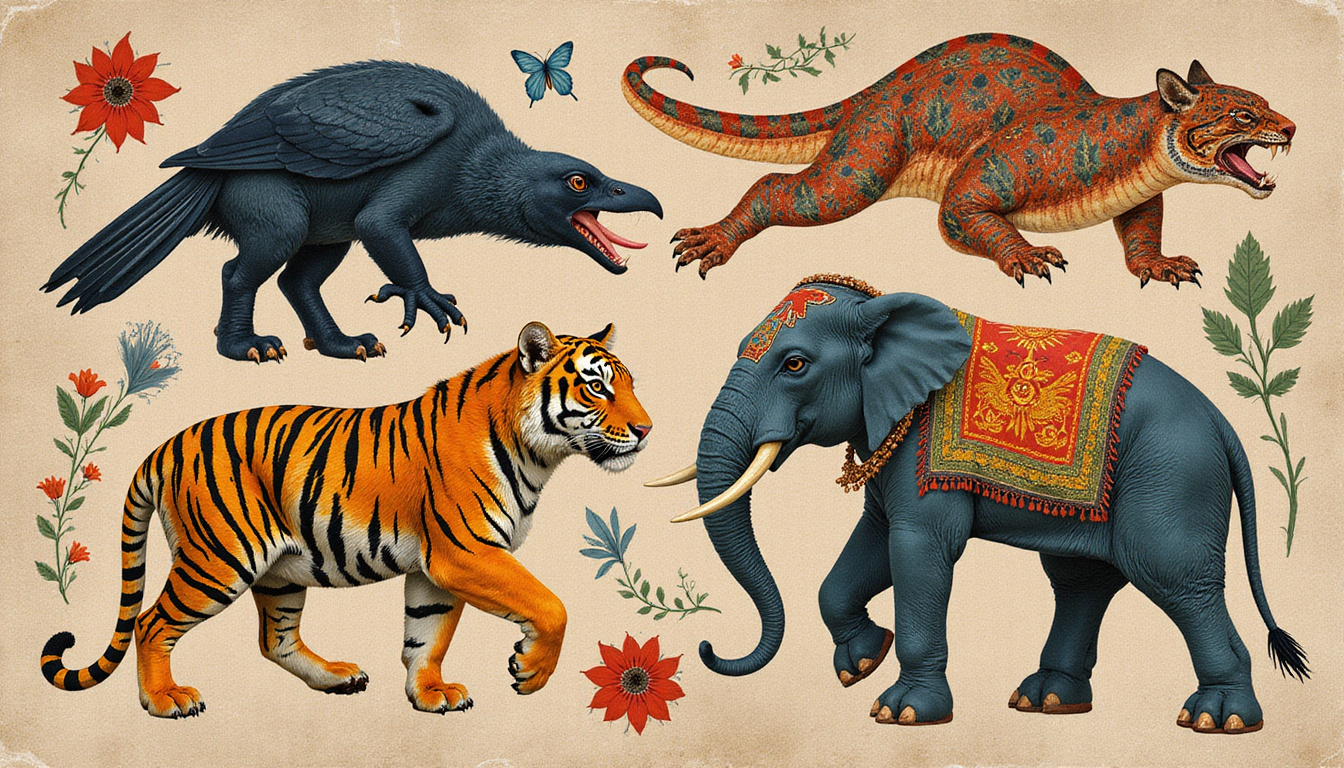
Literature and film: from fables to mascots
Faunal symbolism thrives in stories:
-
Fables and fairy tales:
- Fox → cunning; often charming but untrustworthy.
- Donkey → stubbornness or underestimated wisdom.
- Goose → foolishness (the “silly goose” trope).
-
Modern literature:
- George Orwell’s Animal Farm uses pigs, horses, and other animals as political allegories.
- In many fantasy novels, dragons, wolves, and ravens carry epic or prophetic symbolism.
In film and branding, animals become mascots—think of geckos, owls, lions—chosen precisely because their symbolic traits resonate with the brand message.
Psychological and ecological roots of faunal symbolism
The human mind and animal archetypes
Psychologists like Carl Jung argued that certain symbolic animals express deep, shared archetypes of the human psyche—like the wise old owl or the devouring beast. While this theory is debated, it points to an important fact: animals are powerful mirrors.
When we see:
- A graceful deer → we think of gentleness and vulnerability.
- A massive bear → we imagine dormant power and protective ferocity.
We are projecting ourselves—our fears, desires, and ideal selves—onto other species.
Ecology and lived experience
At the same time, faunal symbolism is not only mental; it’s ecological. Animals that are:
- Dangerous become symbols of fear or respect.
- Essential to survival become sacred or taboo.
- Rare or strikingly beautiful become emblems of uniqueness or divinity.
Anthropologists note that much symbolism tracks closely with local environments and livelihoods (source: Encyclopedia Britannica – Animal worship).
Modern uses: tattoos, logos, and personal identity
Personal symbolism: tattoos, jewelry, and dreams
Today, many people choose animal imagery to express identity, goals, or values:
- A wolf tattoo: desire for freedom, pack loyalty, or resilience.
- A butterfly pendant: transformation after hardship.
- A hummingbird: joy, lightness, and adaptability.
Online dream dictionaries often list faunal symbolism, though interpretations vary widely. The most meaningful interpretation usually blends cultural traditions with the dreamer’s personal associations.
Branding and social movements
Companies and organizations deliberately tap into shared animal meanings:
- Eagle or falcon logos: speed, boldness, strategic vision.
- Elephant for conservation groups: memory, endangered majesty, environmental responsibility.
- Dove for peace organizations: reconciliation and hope.
Social and political movements do the same: from the bear as a symbol of Russia to elephants and donkeys in U.S. politics, animals carry instantly recognizable messages.
How to interpret faunal symbolism thoughtfully
Because animal meanings are layered and context-dependent, avoid one-size-fits-all answers. When you encounter faunal symbolism, ask:
- Which culture and time period? A snake in ancient Greece (healing and rebirth) differs radically from a snake in medieval Christian art (temptation and evil).
- What is the animal’s local ecology? Is it feared, revered, eaten, or protected?
- What’s the artistic or narrative context? Is it a religious icon, a satire, a logo, or a personal tattoo?
- What personal associations do you bring? Your own experiences with an animal strongly color its meaning.
This layered approach respects cultural nuance and keeps faunal symbolism from becoming shallow or stereotypical.
FAQ: faunal symbolism and animal meanings
Q1: What is faunal symbolism in mythology?
Faunal symbolism in mythology is the use of animals to represent gods, cosmic forces, or moral themes within mythic stories. For example, the wolf that nurses Romulus and Remus in Roman myth symbolizes both the wild origins of Rome and a protective, maternal power.
Q2: How is animal symbolism used in art and culture?
Animal symbolism in art and culture appears in religious icons, folk tales, coats of arms, film, advertising, and personal body art. Each instance of faunal symbolism communicates ideas—such as loyalty, danger, transformation, or purity—through the visual or narrative presence of animals.
Q3: Do animals have universal symbolic meanings across cultures?
Some patterns are widespread, like predators symbolizing power or birds symbolizing transcendence, but faunal symbolism is never fully universal. A snake, owl, or dog can mean radically different things depending on religion, geography, and historical moment, so cultural context is essential for accurate interpretation.
Understanding faunal symbolism reconnects you with an ancient human practice: reading the animal world as a living text. As you look at the stories, artworks, brands, and personal symbols around you, notice how often animals carry the emotional weight. If you’re creating your own myth—whether through writing, design, art, or personal ritual—consider which creatures best embody your values and aspirations.
Start a journal, mood board, or sketchbook of the animals that recur in your life and imagination. Explore their cultural histories alongside your personal experiences. By consciously working with faunal symbolism, you not only decode the meanings others have embedded in animals—you also craft a more intentional, resonant symbolic language of your own.
Animals have inspired symbols and beliefs across cultures for centuries. Discover how these traditions connect with psychology, spirituality, and human consciousness at SpiritualMindScience.com.