The crucifix is one of the most widely recognized religious symbols in the world. Instantly associated with Christianity, it carries layers of meaning that touch on sacrifice, love, suffering, hope, and redemption. Yet beyond its role in churches and devotions, the crucifix also shapes art, culture, fashion, and even public debate. Understanding what the crucifix really represents requires looking at its history, symbolism, and the many ways it is used today.
What Is a Crucifix?
At its most basic, a crucifix is a cross bearing the body (corpus) of Jesus Christ. This distinguishes it from a plain Christian cross, which does not show Christ’s body. The crucifix visually recalls the crucifixion of Jesus as described in the New Testament and is particularly central in Roman Catholicism, Eastern Orthodoxy, and some Anglican and Lutheran traditions.
Three core elements normally define a traditional crucifix:
- A cross, usually in the Latin cross form (long vertical beam, shorter horizontal beam)
- The figure of Christ, often nailed through hands and feet
- The inscription “INRI” above his head (“Jesus of Nazareth, King of the Jews” in Latin)
From this seemingly simple form, an entire universe of theology, spirituality, and artistic tradition unfolds.
Historical Origins of the Crucifix
Early Christian Reluctance
The earliest Christians were slow to use the crucifix as a visual symbol. Crucifixion was a brutal, shameful Roman execution reserved for criminals and rebels. For the first few centuries, Christians tended to use more discreet or symbolic imagery, such as:
- The chi-rho (XP) monogram of Christ
- The fish (ichthys)
- The good shepherd
- Simple, undecorated crosses
Representing Jesus’ shameful death in graphic detail would have been socially and emotionally difficult when crucifixions were still being practiced and seen regularly.
Emergence in Late Antiquity
By the 4th century, after Christianity was legalized in the Roman Empire under Constantine, more explicit representations of the crucifixion emerged. Early crucifixes sometimes depicted Christ alive and triumphant, emphasizing his divinity and victory over death rather than his suffering.
From the 6th to 10th centuries, the crucifix became more standardized in churches and religious art across Europe and the Middle East. These early forms laid the groundwork for the fully developed crucifix iconography of the Middle Ages.
Medieval Development
The Middle Ages saw a dramatic evolution in crucifix art and symbolism:
- Christ was increasingly shown suffering: thin, wounded, with visible blood and agony.
- Large crucifixes were placed above altars, in processions, and at crossroads.
- Monastic and devotional spirituality focused intensely on Christ’s Passion.
This shift mirrored a growing emphasis on Christ’s humanity—his pains, wounds, and emotions—as a source of comfort and identification for believers. The crucifix became the emotional center of Christian piety in Western Europe.
Reformation and Diverging Traditions
The Protestant Reformation (16th century) caused significant debates over religious imagery, including the crucifix:
- Many Protestant groups removed crucifixes from churches, viewing them as potential idols.
- They preferred the empty cross as a sign of the risen Christ and the completed work of salvation.
- Catholic and Orthodox churches retained the crucifix firmly at the heart of liturgy and devotion.
These differences still shape how the crucifix appears (or doesn’t appear) in churches today.
Core Symbolism of the Crucifix
The crucifix is rich with overlapping layers of meaning. For Christians, it is not a mere decorative symbol, but a visual summary of their core beliefs.
1. Sacrifice and Atonement
The most foundational meaning of the crucifix is Christ’s sacrificial death for the salvation of humanity. In Christian theology, Jesus voluntarily accepts suffering and death to reconcile humanity with God. The crucifix visually communicates:
- Self-giving love
- The cost of forgiveness
- The seriousness of sin and brokenness
This sacrificial aspect is especially emphasized in Catholic and Orthodox theology, where the crucifix is closely tied to the Eucharist and the sacrificial language of the Mass or Divine Liturgy.
2. Love and Compassion
A second, profoundly emotional dimension is love. The crucifix portrays a God who enters human suffering rather than stays distant from it. For many believers, praying before a crucifix brings comfort in times of grief, illness, or injustice, suggesting:
- “You are not alone in your pain.”
- “God understands suffering from the inside.”
- “Love is willing to endure hardship for the beloved.”
This understanding is central to Christian spirituality and pastoral care.
3. Suffering and Solidarity
The crucifix also speaks of solidarity with the oppressed, poor, and marginalized. The crucifixion was a political execution of a perceived troublemaker. As such, the crucifix can be read as:
- A critique of unjust power and violence
- A sign that God identifies with victims, not oppressors
- A symbol of hope in the face of persecution
Liberation theology and various Christian social movements have drawn heavily on this aspect of crucifix symbolism.
4. Victory and Resurrection (Paradoxically)
Although the crucifix shows death, Christians interpret it as the doorway to resurrection and new life. The paradox is central: the lowest point (the cross) is also the turning point. Thus the crucifix symbolizes:
- Victory through apparent defeat
- Life arising from death
- Hope in the face of despair
Icons and crucifixes in Eastern Christianity often highlight this triumphant aspect, depicting Christ serene and regal, even while crucified.
Types of Crucifixes and Their Distinct Meanings
Different Christian traditions and cultures have developed specific styles of crucifix, each emphasizing particular theological or devotional themes.
Catholic Crucifix
The Catholic crucifix is perhaps the most familiar:
- Emphasizes Christ’s suffering and sacrificial love
- Common in churches, on rosaries, and in homes
- Required on or near the altar in Catholic liturgy
Catholic teaching often points to the crucifix as a reminder of Christ’s real, physical sacrifice made present in the Eucharist.
Orthodox Crucifix
Eastern Orthodox crucifixes and icons of the crucifixion have distinctive features:
- Christ often appears calm and noble, highlighting his divine control.
- The cross sometimes has three crossbars, including a slanted footrest.
- Inscriptions and symbolic elements (like the skull of Adam beneath the cross) add layers of meaning.
The Orthodox approach blends both suffering and victory, with a strong emphasis on mystery and divine glory.
Protestant Use of the Crucifix
Many evangelical and Reformed Protestant churches prefer the plain cross because:
- They want to stress the resurrection and empty tomb.
- They are wary of possible idolatry or over-focus on physical images.
However, some Protestant traditions, like many Anglicans and Lutherans, do use crucifixes, especially in high-church or liturgical settings.
Everyday Uses of the Crucifix Today
The crucifix is not confined to church walls. It appears in a wide range of everyday contexts, each with slightly different significance.
In the Home
Many Christian families display a crucifix:
- Above a bed or in a bedroom
- In a central place like the living room or near a prayer corner
- Near the entrance as a sign of blessing and protection
For the faithful, this creates a constant reminder of God’s presence and love in daily life.
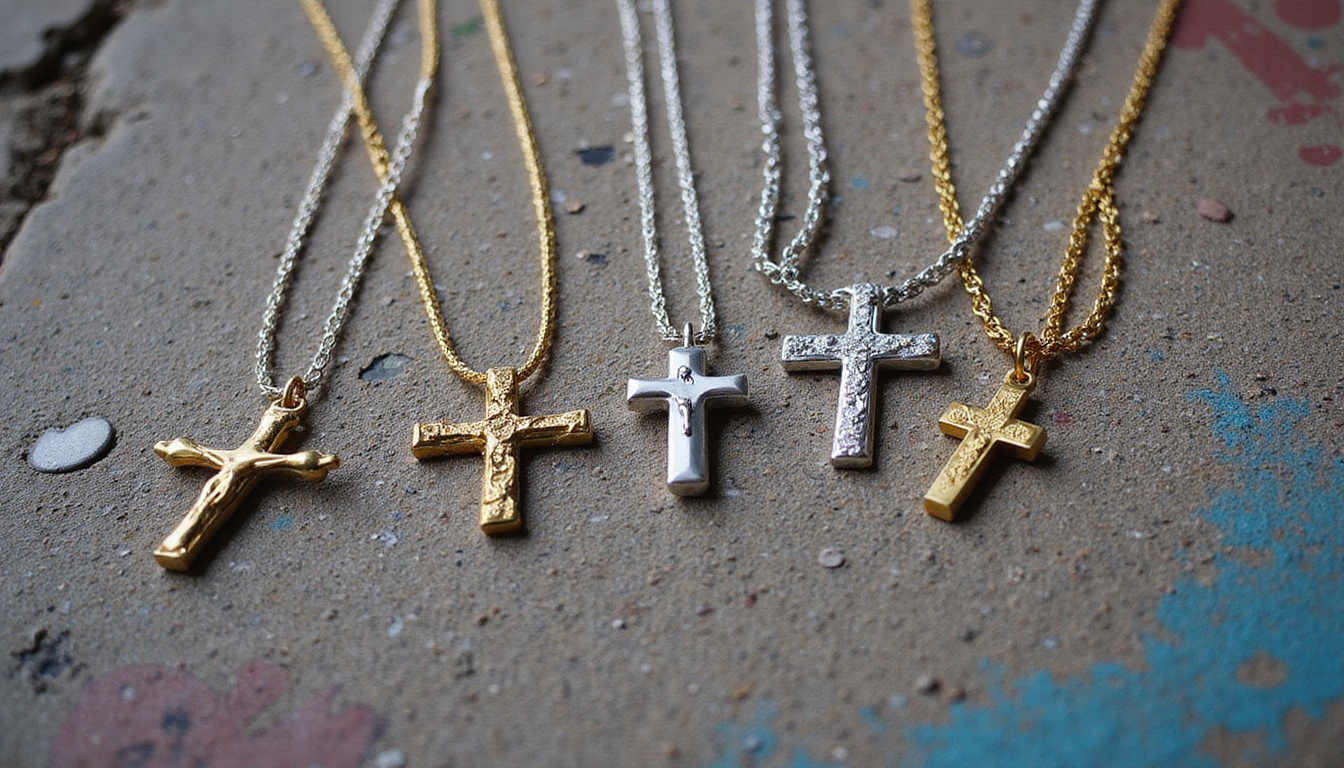
In Personal Devotion
Individuals carry or wear a crucifix for spiritual reasons:
- Around the neck as a sign of faith and identity
- On a rosary for meditative prayer
- In a pocket or bag as a source of comfort
For many, touching or looking at a crucifix in a moment of fear or temptation is a physical way to refocus on faith.
In Churches and Public Worship
Within liturgical settings, crucifixes have specific roles:
- A large crucifix above or near the altar as a focal point
- Processional crucifixes carried in at the start of Mass or services
- Smaller crucifixes on altars, in confessionals, or in chapels
These uses underscore the centrality of Christ’s sacrifice in Christian worship.
As Jewelry and Fashion
The crucifix also appears widely as jewelry and fashion accessories. This can have varied motivations:
- Genuine expression of Christian faith
- Cultural or family tradition (e.g., received at baptism or first communion)
- Purely aesthetic or “edgy” fashion, sometimes detached from religious meaning
This secularized use raises questions: Is it appropriate to use a crucifix merely as a style element, without regard to its spiritual significance? Opinions differ widely among both believers and non-believers.
Controversies and Debates Surrounding the Crucifix
Because of its religious power and public visibility, the crucifix has also sparked controversy.
Public Display and Secular Spaces
Court cases and debates have arisen around the presence of crucifixes in:
- Public schools and classrooms
- Courtrooms and government buildings
- Hospitals or military facilities in secular states
Some argue they are historical or cultural symbols; others see them as religious endorsements inappropriate for neutral public spaces. Different countries and courts reach different conclusions (source: European Court of Human Rights).
Art, Blasphemy, and Free Expression
Artists occasionally use the crucifix in provocative or critical works:
- To protest church abuses or hypocrisy
- To explore themes of suffering, identity, and politics
- To shock or question religious authority
Such works can be praised as powerful commentary by some and condemned as blasphemous by others, highlighting the crucifix’s emotional charge in public culture.
How to Choose and Use a Crucifix Meaningfully
For those who wish to engage the crucifix thoughtfully, a few guidelines can help:
-
Clarify your intent.
Are you drawn for spiritual, cultural, artistic, or fashion reasons? Being honest about intent shapes how you use and respect the symbol. -
Respect its sacred meaning.
Even if you are not a believer, recognizing that the crucifix is deeply sacred to many can guide more considerate choices (where you wear it, how you present it, etc.). -
Select a style that matches your tradition or values.
- Catholics may prefer a more traditional altar-style or rosary crucifix.
- Orthodox Christians might choose an iconographic or three-bar cross crucifix.
- Those focused on social justice may be drawn to crucifixes that highlight suffering and solidarity.
-
Integrate it into practice, not just decoration.
For believers, the crucifix becomes more meaningful when connected to prayer, reflection, or acts of service—moving it beyond mere ornament.
FAQ: Crucifix, Cross, and Christian Symbols
1. What is the difference between a crucifix and a cross?
A crucifix is a cross that includes the body (corpus) of Jesus, usually nailed to it, emphasizing his crucifixion and sacrificial death. A cross is the bare shape without Christ’s body. Many Protestants favor the simple cross to focus on the resurrection, while Catholics and Orthodox Christians rely heavily on the crucifix for devotion.
2. Why do Catholics wear a crucifix instead of just a cross?
Catholics wear the crucifix to keep Christ’s Passion visually present at all times. It reminds them of Jesus’ concrete, historical suffering and the belief that his sacrifice continues to have saving power today, especially in the Eucharist. The crucifix is seen as a powerful sign of both love and protection.
3. Is it disrespectful to wear a crucifix as jewelry if I’m not religious?
Reactions differ. Some believers see any public display of the crucifix as potentially positive, hoping it might spark reflection. Others feel using the crucifix purely as an aesthetic object trivializes a sacred symbol. If you choose to wear a crucifix without sharing its faith meaning, doing so with awareness and respect—avoiding mocking or degrading contexts—can reduce offense.
The crucifix is more than carved wood or polished metal. It is a dense symbol that condenses centuries of faith, suffering, art, and hope into a single image. To some it is a scandal, to others a comfort; to many it is the clearest visual statement of what Christianity believes about God and humanity.
If you’re drawn to the crucifix—whether spiritually, culturally, or artistically—go deeper than the surface. Study its history, reflect on its meanings, and, if you are a person of faith, let it shape your daily life and choices. Consider adding a thoughtfully chosen crucifix to your home, your personal prayer space, or your devotional practice, and let this ancient symbol speak freshly into your modern world.
Sacred objects often carry deep cultural and spiritual meaning. Learn how these symbols relate to history, spirituality, and the human mind by exploring more articles at SpiritualMindScience.com.