Animal mythology is as old as storytelling itself. Across cultures and centuries, humans have looked to animals—real and imagined—to explain natural forces, express moral truths, and explore spiritual beliefs. From dragons to phoenixes, these mythical creatures carry deep symbolism that still shapes books, films, religions, and even brand logos today.
In this guide, we’ll explore seven of the most iconic beasts in animal mythology, what they meant to the cultures that created them, and why their stories still resonate.
1. Dragons: Power, Chaos, and Cosmic Balance
Few figures in animal mythology are as widespread—or as contradictory—as the dragon. Dragons appear in Europe, Asia, the Middle East, and the Americas, yet their meanings vary dramatically.
Eastern Dragons: Wisdom and Good Fortune
In Chinese, Korean, and Japanese traditions, dragons are usually benevolent:
- Symbol of imperial power – Chinese emperors were considered “sons of the dragon,” and the dragon appeared on royal robes and thrones.
- Bringers of rain and prosperity – In agricultural societies, dragons governed water, rivers, and weather, making them symbols of abundance and good harvests.
- Balance and cosmic order – The Chinese dragon is often paired with the phoenix, representing the harmony of masculine and feminine energies (yang and yin).
These dragons are typically long, serpent-like creatures without wings, combining features of multiple animals: deer antlers, fish scales, eagle claws, and camel head.
Western Dragons: Greed, Danger, and the Hero’s Trial
In European animal mythology, dragons tend to be:
- Winged, fire-breathing, and horned
- Hoarders of treasure and captors of maidens
- Powerful adversaries that heroes must slay
Stories like St. George and the Dragon or the dragon Fafnir from Norse myth frame the dragon as a symbol of greed, chaos, and evil. Slaying the dragon signifies defeating inner vices or restoring social order.
Why Dragons Endure
Across cultures, dragons represent overwhelming power—whether benevolent or destructive. In modern fantasy and pop culture, they often appear as complex beings: dangerous yet wise, monstrous yet majestic. They mirror our ambivalence about power itself.
2. Phoenix: Rebirth, Immortality, and the Cycles of Time
The phoenix is one of the most powerful symbols in animal mythology, representing death and rebirth.
The Firebird That Cannot Die
In ancient Greek and later Roman accounts, the phoenix is a radiant bird—often associated with gold, red, or purple plumage—that lives for centuries. When it senses its end approaching, it:
- Builds a nest of aromatic wood
- Sets itself and the nest on fire
- Is consumed by flames
- Is reborn from the ashes, either as a new bird or an egg
Variants of the phoenix myth appear in Egyptian, Persian, and Chinese traditions (e.g., the Fenghuang, sometimes called the Chinese phoenix).
Symbolic Meanings
The phoenix has become shorthand for:
- Spiritual resurrection
- Personal transformation after hardship
- The endurance of the soul or spirit
- Historical rebirth of nations or cities after disaster
Today, we use “phoenix rising from the ashes” as a metaphor for anyone or anything that comes back stronger after failure or destruction.
3. Griffins: Guardians of Treasure and Integrity
A lesser-known but influential figure in animal mythology, the griffin combines the body of a lion with the head and wings of an eagle.
Hybrid of Two Kings
The symbolism is straightforward:
- Lion – King of beasts (land), representing strength and courage
- Eagle – King of birds (sky), representing vision and authority
Together, the griffin becomes a super-guardian, associated with protecting:
- Gold and precious stones
- Sacred places and divine secrets
- Royal families and noble lineages
In ancient Near Eastern and Greek art, griffins appear near thrones, temples, and burial sites, marking spaces of power and reverence.
Moral and Spiritual Symbolism
In medieval Europe, griffins took on Christian meanings:
- Guardians of the divine and spiritual truth
- Symbols of vigilance, justice, and fidelity
Because they never slept in some tales, they became emblems of constant watchfulness—a reminder to remain morally alert and protective of what truly matters.
4. Unicorns: Purity, Mystery, and the Untamed Sacred
Unicorns are often dismissed as cute fantasy creatures, but in classical and medieval animal mythology, they carried deep spiritual and cultural weight.
The Elusive One-Horned Beast
Descriptions vary, but the traditional unicorn is:
- Horse-like (sometimes goat-like)
- White or pale in color
- Bearing a single long, spiraled horn
Early Greek writers such as Ctesias may have based unicorn descriptions on Indian rhinoceroses (source: Encyclopaedia Britannica). Over time, legends grew around the unicorn:
- Its horn could neutralize poison
- It could not be captured by force
- It would only approach a pure maiden
Symbolism in Medieval Europe
In Christian symbolism, the unicorn came to represent:
- Purity and chastity
- Christ himself, with the capture of the unicorn symbolizing the Incarnation
More broadly, unicorns stand for:
- The rare and unattainable—goals or ideals beyond ordinary reach
- The sacred within nature, wild yet holy
The enduring popularity of unicorns in modern culture reflects our ongoing fascination with innocence, authenticity, and the dream of something pure in a complicated world.
5. Wolves: Between Protector, Predator, and Spirit Guide
Wolves are a prime example of how animal mythology can swing between fear and reverence.
Wolves in European Myth: Threat and Wilderness
In much of traditional European folklore, wolves were:
- Dangerous predators, especially to livestock
- Symbols of the untamed forest and unknown dangers
- Associated with night, cold, and famine
Stories like “Little Red Riding Hood” crystallize the wolf as a cunning, predatory force. In Christian allegory, the wolf often represents the Devil or false shepherds.
Wolves in Norse and Roman Myths
Norse mythology complicates this picture:
- Fenrir, a monstrous wolf, is destined to kill Odin at Ragnarök—pure destruction and cosmic chaos.
- Yet Geri and Freki, Odin’s companion wolves, symbolize loyalty and warlike strength.
In Roman myth, the she-wolf that suckles Romulus and Remus is a nurturing figure, embodying both the wild and the founding of civilization.
Wolves in Indigenous North American Traditions
Many Native American cultures see the wolf as:
- A teacher and pathfinder
- A symbol of loyalty, family, and cooperation
- A powerful spirit guide
This view emphasizes the social intelligence of wolves and their strong pack bonds, reflecting values of community and shared responsibility.
6. Serpents: Primordial Power, Wisdom, and Renewal
Snakes and serpents appear in nearly every body of animal mythology, often with double or triple meanings.
Sacred and Dangerous at Once
Common motifs include:
- Renewal and rebirth – Because they shed their skin, snakes symbolize transformation and the cyclical nature of life.
- Wisdom and secret knowledge – In some cultures, they guard or transmit hidden teachings.
- Chaos and threat – Venom and stealth make them figures of danger and betrayal.
Examples Across Cultures
- Norse Mythology – Jörmungandr, the World Serpent, encircles the earth and holds the oceans in place. When he releases his tail, Ragnarök begins. He embodies both cosmic structure and its eventual unraveling.
- Greek Mythology – Asclepius, god of healing, wields a staff with a coiled serpent, connecting snakes to medicine and rebirth. (This survives in the modern medical symbol.)
- Mesoamerican Mythology – Quetzalcoatl, the “feathered serpent,” is a deity of wind, learning, and creation, uniting earth (serpent) and sky (bird).
In the Biblical tradition, the serpent in Eden becomes a symbol of temptation and moral fall, contributing to the snake’s negative image in later Western culture.
7. Sphinx: Riddle, Threshold, and the Mystery of Knowledge
The sphinx is a striking hybrid in animal mythology, merging human and animal forms to express puzzles of power and wisdom.
Egyptian Sphinx: Royal Power and Protection
The Egyptian sphinx—like the Great Sphinx of Giza—has:
- A lion’s body
- A human (usually male) head
It represents:
- Royal authority and divine kingship
- Guardianship of sacred sites and tombs
- The fusion of human intelligence with animal strength
Sphinx statues were positioned to flank avenues and temple entrances, silently asserting the pharaoh’s protective oversight.
Greek Sphinx: The Deadly Questioner
The Greek version of the sphinx (typically female-headed) is more sinister. In the story of Oedipus, she:
- Blocks the road to Thebes
- Asks a riddle: “What walks on four legs in the morning, two at noon, and three in the evening?”
- Kills all who answer incorrectly
Oedipus answers correctly—“a human”—and the sphinx destroys herself.
Symbolically, the Greek sphinx is:
- A guardian of thresholds—between ignorance and understanding, life and death
- A personification of unsolved problems and existential questions
- A reminder that knowledge can be both dangerous and liberating
What Animal Mythology Reveals About Us
Looking across cultures, a pattern emerges: animal mythology is never just about animals. It’s about human concerns projected onto the natural world.
Here’s what these legendary beasts collectively express:
- Our fears – Dragons, wolves, and serpents give shape to chaos, predation, disease, and the unknown.
- Our hopes – Phoenixes, unicorns, and benevolent dragons embody renewal, purity, justice, and prosperity.
- Our moral struggles – Griffins and sphinxes guard moral and intellectual boundaries, forcing choices and tests.
- Our relationship with nature – Myths encode respect, fear, and dependency on the natural world, reminding us that we are part of larger ecological and cosmic systems.
In modern storytelling—novels, films, games—these creatures still carry these layers of meaning, whether explicitly or subconsciously.
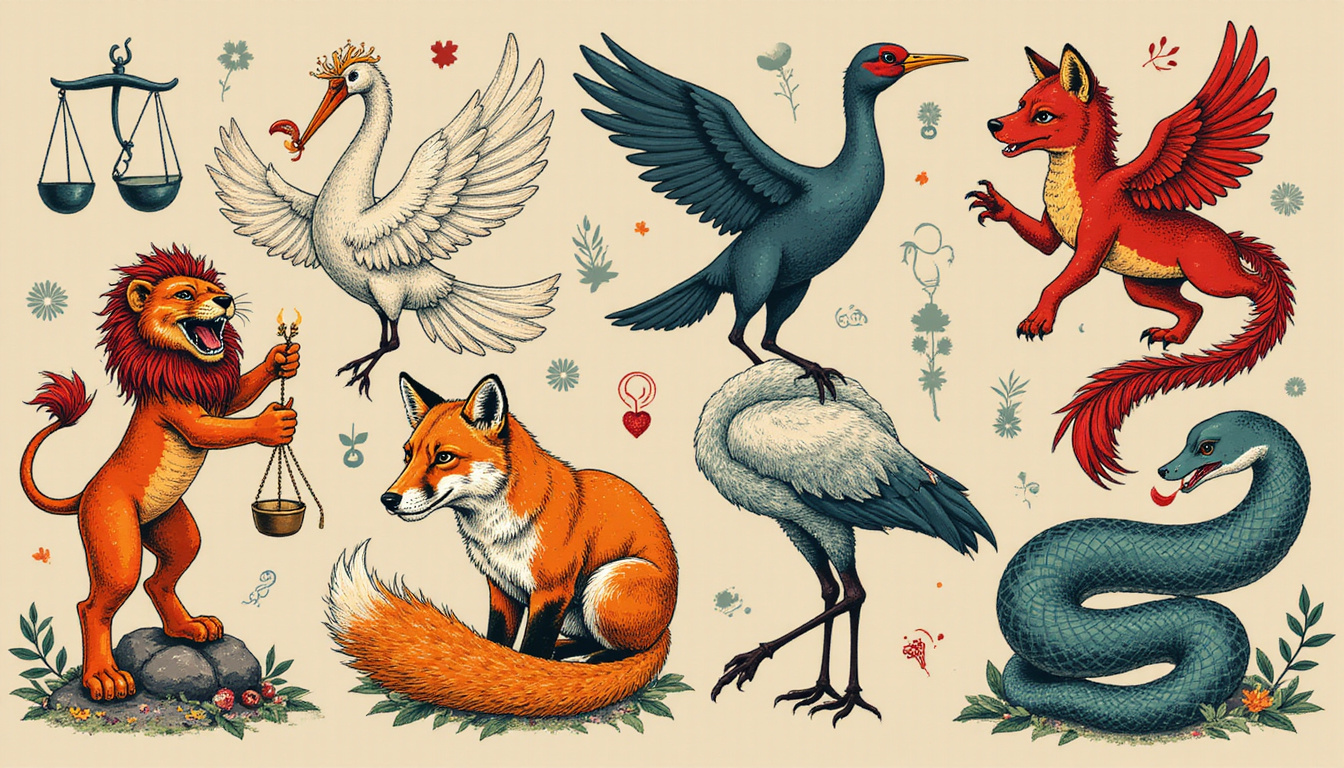
Common Themes in Animal Mythology
Across thousands of stories, several recurring themes appear:
- Hybridity – Creatures like griffins and sphinxes combine species, symbolizing the meeting of worlds: human and animal, earth and sky, mortal and divine.
- Guardianship – Many beasts guard thresholds: city gates, treasure hoards, sacred knowledge, or life-and-death passages.
- Transformation – Phoenixes, serpents, and even wolves often represent cycles of change, reminding us that loss and renewal are intertwined.
- Moral Allegory – Dragons of greed, wolves of predation, unicorns of purity: animals encode ethics into memorable forms.
Understanding these patterns helps decode not just old myths, but also the symbolic language of modern media and culture.
FAQ: Exploring Animal Mythology and Legendary Creatures
Q1: What is animal mythology and why is it important?
Animal mythology is the body of myths, legends, and sacred stories that feature animals—real or imaginary—as central figures. It matters because it reflects how different cultures understand nature, morality, power, and the divine. Studying animal mythology reveals shared human concerns and unique cultural perspectives.
Q2: Which mythical animals are the most influential in world myths?
Some of the most influential creatures in animal mythology include dragons, phoenixes, unicorns, griffins, wolves, serpents, and sphinxes. Their stories have shaped religious symbolism, heraldry, literature, and modern fantasy, and their meanings continue to evolve in contemporary culture.
Q3: How do mythological animals differ across cultures?
The same type of creature can embody very different values. For example, in Asian animal mythology, dragons are often wise and protective, while in much of European tradition, they represent greed and evil. Wolves can be demonic predators in some tales and spiritual guides in Indigenous North American stories. These differences reveal each culture’s environment, history, and worldview.
Animal mythology isn’t just a relic of the past; it lives on in the symbols we wear, the stories we love, and the metaphors we use every day. If these legendary beasts spark your curiosity, dig deeper into the myths of specific cultures—Norse sagas, Chinese classics, Indigenous oral traditions, Greek epics—and notice how familiar creatures take on new dimensions.
Let these seven legendary beings be your starting point. Explore their stories, question their meanings, and use them as a lens to better understand both the ancient world and your own inner landscape. The next time a dragon, phoenix, or wolf appears in a book, film, or dream, you’ll have the tools to read the deeper message—and perhaps to write a myth of your own.
Animals have inspired symbols and beliefs across cultures for centuries. Discover how these traditions connect with psychology, spirituality, and human consciousness at SpiritualMindScience.com.