Animal emblems have been part of human culture for thousands of years, shaping how societies see themselves, their enemies, and the natural world. From flags and coins to sports logos and spiritual symbols, animal emblems carry more meaning than many people realize. They can represent courage, wisdom, protection, heritage, or even national identity—and their origins are often surprising.
This guide unpacks where animal emblems come from, what they mean, and why they still hold such cultural power today.
What Are Animal Emblems?
At their core, animal emblems are symbolic representations of animals used to convey an idea, value, group, or identity. They can appear as:
- National symbols (e.g., bald eagle for the United States)
- Heraldic crests and coats of arms
- Military insignia
- Religious and spiritual icons
- Clan, tribe, or family symbols
- School and sports team mascots
- Corporate logos and brand marks
Unlike realistic depictions of animals, animal emblems are stylized, simplified, or idealized. They aren’t about the actual biology of the animal as much as the story humans project onto that animal—such as strength, loyalty, cunning, or freedom.
Ancient Origins of Animal Emblems
The use of animal emblems is far older than modern nations and brands. Archaeology and anthropology show that early humans turned to animals for symbolic meaning very early in our history.
Prehistoric and Tribal Roots
Cave paintings suggest that animals were associated with ritual, myth, and identity long before written language. Later, many Indigenous cultures around the world developed totemic systems where clans or families adopted specific animals as spiritual and symbolic guides.
- Totem animals among some Native American and First Nations groups indicated lineage, spiritual allies, and social roles.
- In parts of Africa, animal emblems were historically linked to royal lineages, warriors, and hunters.
- In ancient Eurasia, nomadic tribes used beasts like horses, wolves, and eagles as emblems on standards, jewelry, and weapons.
In these contexts, animal emblems weren’t just decorative—they were deeply woven into cosmology, law, and social structure.
Animal Emblems in Early Civilizations
As complex civilizations developed, animal emblems became more formalized:
- Ancient Egypt: Gods and goddesses merged with animal features—Horus the falcon, Anubis the jackal, Bastet the cat. These were both religious icons and political emblems of royal authority.
- Mesopotamia: Lions, bulls, and eagles signified kingship, protection, and divine favor, often carved into palace gates and seals.
- Indus Valley and early Chinese cultures: Seals and artifacts depict unicorn-like creatures, tigers, dragons, and bulls that likely functioned as clan or trade emblems.
Already, we see a pattern: animal emblems help bridge human power and the awe-inspiring qualities of the natural world.
Animal Emblems in Heraldry and Medieval Europe
No discussion of animal emblems is complete without heraldry—the highly codified system of coats of arms in medieval Europe.
The Rise of Heraldic Animals
From the 12th century onward, European knights and noble families adopted animal emblems on shields, banners, and armor so they could be recognized in battle and in tournaments. Heraldic rules turned animal symbolism into a kind of visual language.
Common heraldic animal emblems included:
- Lion: Courage, nobility, royalty, valor
- Eagle: Power, sovereignty, vision
- Boar: Ferocity, endurance, bravery
- Stag: Peace, purity, regeneration
- Wolf: Leadership, cunning, loyalty to the pack
- Griffin, dragon, wyvern: Hybrid creatures mixing animal traits with myth, symbolizing supernatural power
Each pose or style (rampant, passant, displayed, etc.) carried a specific meaning, turning animal emblems into highly nuanced identity markers.
Political and Religious Dimensions
Animal emblems also became shorthand for alliances and rivalries:
- The white rose and red rose wars in England coexisted with animal-based house symbols.
- Monarchs claimed divine right using animals associated with Christian or classical symbolism, such as lambs (innocence) or lions of Judah (biblical lineage).
By this time, animal emblems were inseparable from questions of power, loyalty, and legitimacy.
National Animal Emblems and Identity
Modern nation-states embraced animal emblems to crystallize complex histories and values into a single, emotionally powerful image.
Famous National Animal Emblems
A few well-known examples:
- United States – Bald Eagle: Chosen in 1782 as the emblem of strength, independence, and freedom, the bald eagle appears on the Great Seal, currency, and government insignia.
- United Kingdom – Lion and Unicorn: The lion symbolizes England’s royal courage and sovereignty, while the unicorn represents Scotland, often interpreted as wild strength tamed by unity.
- India – Bengal Tiger: Represents majesty, strength, and biodiversity; often associated with the country’s rich wildlife heritage.
- China – Dragon: Unlike its Western counterpart, the Chinese dragon is an auspicious symbol of imperial power, luck, and prosperity.
- Russia – Double-Headed Eagle: Evokes the Byzantine legacy and the unity of East and West.
Though these are national symbols, they function as animal emblems in the fullest sense: they condense history, myth, and political ideals into a single creature.
Why Nations Choose Certain Animals
When countries select animal emblems, they tend to look for:
- Native or historically significant species
- Positive or aspirational traits (courage, resilience, wisdom)
- Deep roots in local myth, religion, or folklore
- Visual impact and recognizability
Sometimes, though, the choice reflects historical accident or political compromise as much as “natural” fit.
Cultural Meanings: One Animal, Many Stories
One of the most surprising things about animal emblems is how differently the same animal can be interpreted from culture to culture.
The Owl: Wisdom or Omen?
- Ancient Greece: The owl symbolized Athena, goddess of wisdom and strategy. It appeared on Athenian coins and pottery as a positive emblem.
- Medieval Europe: Owls often suggested darkness or witchcraft.
- Some Indigenous cultures: In certain traditions, owls can foretell death or important change.
A single animal emblem—owl—can therefore mean enlightenment, danger, or transformation depending on the context.
The Snake: Evil or Renewal?
- Judeo-Christian tradition: The serpent is tied to temptation and deceit.
- Ancient Mesoamerica: The feathered serpent (Quetzalcoatl) is a creator god, a bringer of knowledge.
- Healthcare emblems: The Rod of Asclepius (a snake around a staff) symbolizes healing and medicine worldwide (source: World Health Organization).
This diversity of interpretations reminds us that animal emblems say as much about human culture as they do about animals themselves.
Animal Emblems in Religion and Spirituality
Religions have long used animals to express theological and moral ideas.
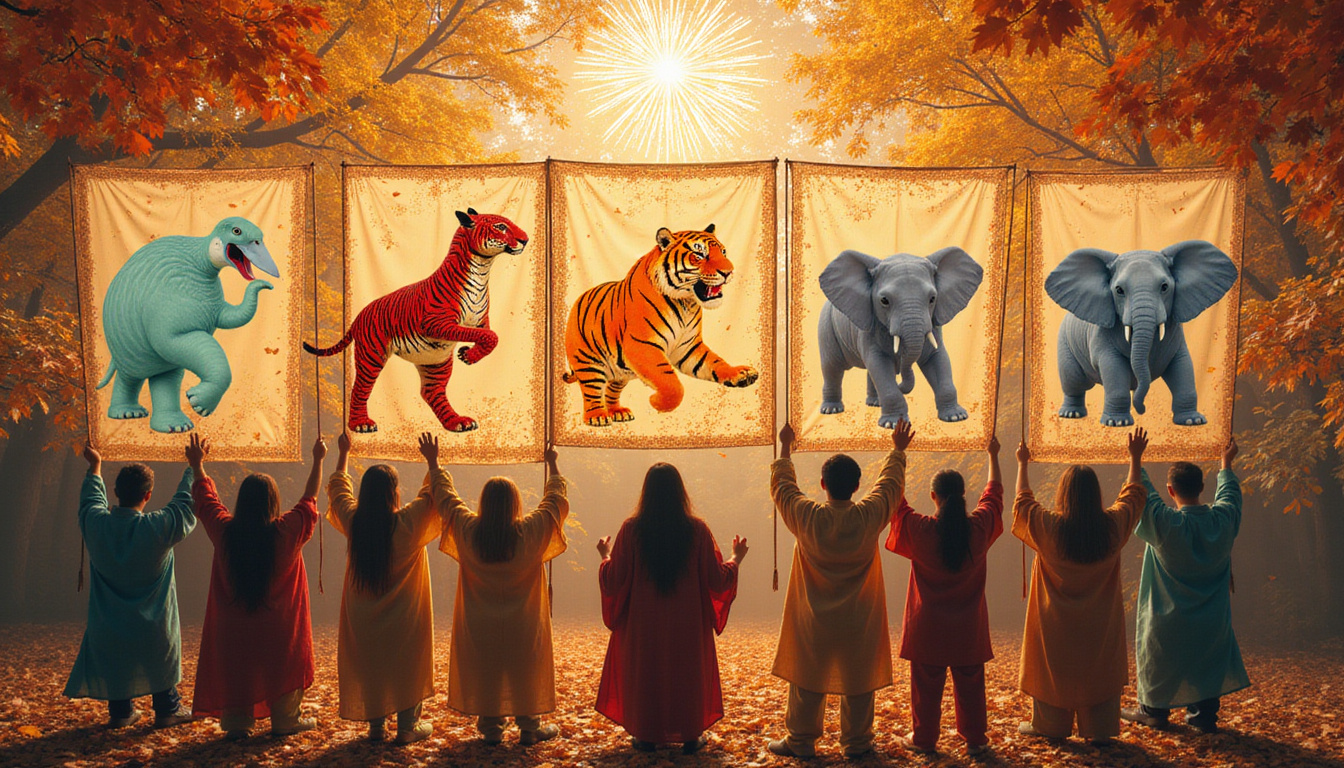
Symbolic Creatures Across Faiths
- Christianity: Lamb (Christ’s innocence and sacrifice), dove (Holy Spirit, peace), lion (Christ as king, also Saint Mark).
- Hinduism: Nandi the bull (vehicle of Shiva), Garuda the eagle (vehicle of Vishnu), and many more vahana (sacred animal mounts) that embody divine attributes.
- Buddhism: Lion (Buddha’s royal authority), deer (first teachings in the Deer Park), elephant (mental strength and steadiness).
- Islamic art (non-figurative contexts aside): Lions, horses, and falcons appear in secular and courtly art among Muslim civilizations, often as emblems of bravery and nobility.
- Shinto and Japanese folk belief: Foxes, cranes, and dragons serve as messengers, protectors, or embodiments of natural forces.
These spiritual animal emblems help believers conceptualize abstract ideas—like purity, compassion, or strength—through familiar living beings.
Modern Uses: From Sports Mascots to Corporate Logos
In the contemporary world, animal emblems are everywhere, even if we don’t always recognize them as such.
Sports Teams and School Mascots
Schools and professional teams often select animal emblems to motivate and unify:
- Predators (eagles, tigers, panthers) to signal aggression and dominance
- Pack or herd animals (wolves, mustangs) to evoke teamwork and spirit
- Mythical beasts (dragons, griffins) to stand out and feel “larger than life”
These emblems can become sources of pride and rivalry, shaping chants, colors, and even local identity.
Branding and Marketing
Companies also harness animal emblems to convey brand values instantly:
- An owl for knowledge or night-time reliability
- A cheetah for speed and performance
- A panda or dolphin for friendliness, playfulness, and approachability
- A bee for industriousness and cooperation
Because animal associations are so intuitive and emotionally charged, they’re powerful tools in visual branding and storytelling.
Ethical and Environmental Dimensions of Animal Emblems
With their popularity, animal emblems also raise ethical questions—and offer opportunities.
Conservation and Responsibility
Some animals used as emblems are endangered in the wild, such as:
- Tigers (national and sports emblems)
- Eagles and vultures
- Rhinos, polar bears, and others used symbolically
This can create tension: using an animal emblem for strength or pride while the real species is at risk. In response, many organizations and countries have linked their symbolic animals to conservation campaigns, funding habitat protection or awareness programs.
Cultural Sensitivity and Appropriation
Animal emblems drawn from Indigenous or sacred contexts can be controversial when used commercially or casually, especially without understanding their significance. Misuse can:
- Flatten complex spiritual traditions into stereotypes
- Offend communities for whom the emblem is sacred
- Reinforce harmful or inaccurate narratives about cultures or animals
Thoughtful use of animal emblems today means asking not only “What does this say about us?” but also “Whose symbol is this—and how should it be used respectfully?”
How to Choose or Interpret an Animal Emblem
Whether you’re designing a logo, picking a school mascot, or just curious about symbolism, it helps to approach animal emblems systematically.
Key Questions to Ask
-
What traits do you want to express?
Strength, intelligence, agility, loyalty, mystery, etc. -
What is the animal’s cultural baggage?
Research how different cultures view the animal to avoid unintended meanings. -
Is the species local or relevant?
Native or historically significant animals often resonate more authentically. -
Are there ethical implications?
Consider conservation status and cultural ownership. -
Does the visual form work?
The animal should be easy to stylize and recognize at different sizes.
By reflecting on these points, you can use animal emblems not just because they look good, but because they tell a story that fits your values and audience.
FAQs about Animal Emblems
1. What are examples of animal emblems in everyday life?
Everyday examples of animal emblems include national animals (like the bald eagle), sports mascots (such as tigers, bears, or hawks), school logos featuring wolves or lions, and brand logos that use animals to signal traits like speed, wisdom, or reliability.
2. How do animal symbols and emblems differ?
Animal symbols can be any use of an animal to represent an idea in art, literature, or religion. Animal emblems are usually more formalized and tied to identity—such as a family crest, national seal, or institutional logo—where the animal is an official or central identifier.
3. Why are animal totems and emblems important in culture?
Animal totems and emblems help communities express their values, ancestry, and worldview through powerful, memorable imagery. They can unify groups, convey moral lessons, act as spiritual guides, and preserve stories about the relationship between people and the natural world.
Animal emblems are far more than decorative creatures on flags and jerseys. They’re compact stories about who we are, what we admire, and how we position ourselves in relation to nature and one another. Whether you’re building a brand, choosing a mascot, or exploring your heritage, understanding these symbols gives you a deeper, more responsible way to use them.
If you’re planning to design or refine an emblem, take the time to research the animals that speak to your message—then shape a symbol that’s meaningful, respectful, and visually striking. When you’re ready, you can share your ideas and we can walk through the symbolism, cultural context, and design choices together to craft an animal emblem that truly resonates.
Animals have inspired symbols and beliefs across cultures for centuries. Discover how these traditions connect with psychology, spirituality, and human consciousness at SpiritualMindScience.com.