Magic circles have fascinated people for centuries, appearing in folklore, ceremonial magic, art, and even modern productivity methods. Today, magic circles are no longer just esoteric symbols; they’re practical tools anyone can adapt for creativity, protection, and meaningful daily rituals—even if you don’t see yourself as “magical” at all.
This guide explores what magic circles are, where they come from, and how you can use them in simple, grounded ways to transform your space, your focus, and your everyday life.
What Are Magic Circles?
At their core, magic circles are intentional boundaries. Traditionally, they’re drawn or visualized as a circle around a practitioner to:
- Define sacred space
- Focus energy and intention
- Mark the boundary between the ordinary and the “set apart”
Historically, magicians, ritualists, and spiritual practitioners have used magic circles to:
- Protect themselves during rituals
- Contain or direct spiritual forces
- Create a focused environment for work, meditation, or prayer
Whether you believe in subtle energies or not, the psychology is clear: when we draw a boundary, we tell our minds, “This space is different. This is where I show up with intention.” That simple mental shift can significantly boost focus, creativity, and emotional grounding.
The History and Symbolism of Magic Circles
Magic circles appear in many cultures and traditions, often with overlapping symbolism.
Ancient and Ceremonial Roots
- Western ceremonial magic: Grimoires from the Middle Ages and Renaissance describe circles inscribed with divine names, symbols, and geometric patterns. These were used for protection and communication with spiritual entities.
- Witchcraft and pagan traditions: Circles are cast to create “sacred space” for rituals, spellwork, or seasonal celebrations, representing wholeness, unity, and the cycles of nature.
- Religious architecture: Circular designs appear in labyrinths, rose windows, and mandalas that invite contemplation and spiritual focus.
Universal Symbolism of the Circle
The circle symbolizes:
- Wholeness and unity
- Infinity and cycles (no beginning, no end)
- Protection and containment
- The self, as in Jungian psychology
Carl Jung used circular diagrams (mandalas) to explore the psyche, observing that people naturally gravitate to circular imagery during times of transformation and healing (source: Encyclopaedia Britannica – Mandala).
From this perspective, magic circles are not just occult tools—they’re profound psychological symbols that mirror our deep need for safety, coherence, and meaning.
Magic Circles for Creativity: A Personal Studio of the Mind
You don’t need candles or sigils to benefit from magic circles. You can harness the concept to spark creativity and enter a “flow” state more easily.
The Circle as a Creative Container
Creativity thrives within boundaries. A magic circle—physical or imagined—acts as a container:
- Physical boundary: A spot in your room, a circle rug, a taped outline, or even a round table.
- Time boundary: A set period you commit to your craft (e.g., 30 minutes of uninterrupted writing).
- Mental boundary: A cue ritual (lighting a candle, putting on headphones, or sketching a circle in your notebook) that tells your brain, “Now we create.”
When you consistently step into your “creative circle,” your mind learns to associate that space with imaginative, focused work.
A Simple Creative Magic Circle Practice
Try this:
- Choose a spot where you can sit or stand comfortably.
- Mark a circle: place objects in a circle around you (books, stones, art supplies) or imagine a circle of light around you.
- Set an intention: “For the next 25 minutes, this circle is for free, judgment-free creation.”
- Begin your creative task—drawing, writing, composing, crafting.
- When the time ends, “close” the circle by thanking the space and putting items away or watching the imagined circle fade.
Repeat this often enough, and the ritual becomes a creativity switch, helping you slip into deep focus faster.
Magic Circles as Protection: Boundary-Setting for Modern Life
Traditional magic circles are most commonly associated with protection. In a modern context, you can reinterpret this in a very practical way: protection from distraction, burnout, and emotional drain.
Energetic and Emotional Protection
You don’t have to believe in literal energetic entities to benefit from the protective symbolism of magic circles. Think of them as:
- A clear “no” to chaos and noise
- A symbolic filter for what you allow into your mental and emotional space
- A reminder that you’re allowed to have boundaries—physically, digitally, and socially
Creating Protective Magic Circles in Everyday Life
Consider these applications:
- Digital circle: Set times when your phone is in another room. During that period, you’re in your “circle” and unavailable for non-urgent messages.
- Work circle: A designated chair, desk, or corner where you don’t scroll social media. When you’re in that circle, you’re task-focused.
- Emotional circle: Before difficult conversations or social events, visualize a circle or bubble of light around you that allows in understanding and respect but reflects hostility or manipulation.
You can also combine physical action with visualization. For instance, draw a small circle on your wrist with a pen before a stressful event and silently affirm: “Within this circle, I am calm, clear, and protected.”
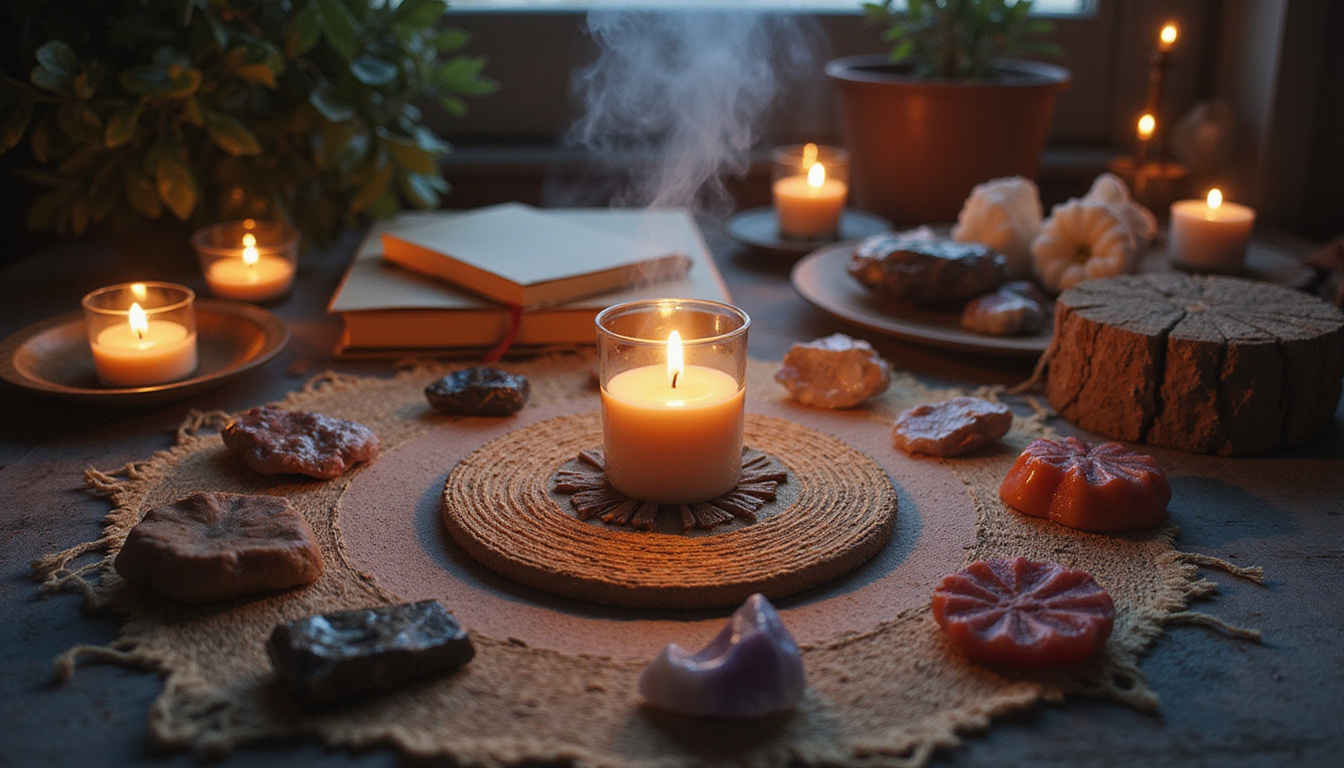
Daily Rituals with Magic Circles: Bringing Sacredness into the Ordinary
Ritual doesn’t have to be grand or complicated. When you integrate magic circles into your daily routines, you infuse everyday life with a sense of meaning and presence.
Morning Grounding Circle
Start your day with a simple circle-based ritual:
- Sit at the edge of your bed or on a cushion.
- Place three objects in a small circle in front of you (e.g., a stone, a pen, a cup of tea).
- One by one, assign each object an intention for the day:
- Stone: stability or courage
- Pen: creativity or communication
- Cup: self-care or nourishment
- Close your eyes for one minute and breathe slowly, imagining a circle of soft light around you.
- Pick up the objects and place them where you’ll see them—on your desk, in your bag, near your sink.
This takes only a few minutes but can dramatically shift how you feel stepping into your day.
Evening Release Circle
Create a closing ritual to mark the end of your day:
- Stand or sit and gently trace a circle in the air in front of you with your hand.
- As you complete the circle, say: “The work of today is complete. What’s left can wait until tomorrow.”
- Imagine everything that doesn’t serve you draining out of the circle and dissolving.
This signals to your nervous system that it’s time to transition away from productivity mode into rest.
How to Create Your Own Magic Circle: Step-by-Step
You can make magic circles as simple or elaborate as you like. Here’s a straightforward approach you can adapt to any belief system.
1. Choose Your Purpose
Before anything else, decide what your circle is for:
- Creativity
- Protection
- Healing
- Focus
- Meditation
Clarity of purpose is more important than any tool or symbol.
2. Select Your Space
Find a spot where you can be relatively undisturbed:
- A corner of your bedroom
- A section of your living room
- A quiet area outdoors
- Even a mental space you visit through visualization
3. Define the Boundary
You can define the circle physically, symbolically, or mentally:
-
Physical:
- Lay out a round rug or mat
- Arrange candles, stones, or books in a circle
- Use a chalk or masking tape outline (if appropriate)
-
Symbolic:
- Place four objects around you (e.g., north/south/east/west) to suggest a circle
- Use a circular object (like a bowl or wreath) to represent your magic circle
-
Mental/visual:
- Close your eyes and imagine a ring of light or fire around you
- Visualize stepping over an invisible line into your special space
4. Set Your Intention
Stand or sit within your magic circle and speak or think your intention clearly. For example:
- “This circle is for focused, joyful creativity.”
- “Within this circle, I am safe, clear, and grounded.”
- “This circle holds my attention gently on my breath.”
5. Add Supportive Elements (Optional)
Consider items that support your purpose:
- Candles or soft lighting for calm and focus
- Music or white noise to block distractions
- Crystals, plants, or symbolic tokens that personally inspire you
- A notebook or sketchbook reserved only for use in your magic circle
6. Use and Close the Circle
Use the circle for your chosen activity. When you’re done:
- Say a short closing phrase like, “This circle is closed; the intention remains.”
- Put away or rearrange objects to mark the end.
- Take one deep, intentional breath as you physically step out of the space.
This beginning-and-ending structure helps your brain shift modes more reliably.
Common Myths and Misunderstandings About Magic Circles
Because magic circles are rooted in occult and spiritual traditions, misconceptions are common. A few clarifications:
- You don’t have to follow any specific religion or path. You can approach magic circles as psychological ritual, creative tool, or spiritual practice—whatever fits your worldview.
- They’re not inherently “dark” or dangerous. A circle is a neutral symbol; its effect depends on your intention and how you use it.
- Complex symbols aren’t required. You don’t need to memorize arcane sigils or scripts. A simple circle, even imagined, can be powerful.
By releasing the pressure to “do it right,” you leave room for experimentation and personal meaning.
Practical Ways to Bring Magic Circles into Everyday Life
Here are some easy, low-pressure ways to work with magic circles regularly:
- Use a round coaster or mat on your desk as a mini magic circle for your morning coffee; while it’s on the mat, set a daily intention.
- Before opening your laptop, trace a small invisible circle over the keyboard and affirm: “Within this circle, I work with clarity and focus.”
- During stressful commutes or crowded spaces, mentally visualize a circle of calm around you, expanding and contracting with your breath.
- For families, create a “circle time” ritual where everyone sits in a rough circle to share one good thing and one challenge from the day.
- In creative workshops or meetings, briefly arrange chairs in a circle to signal openness, equality, and collaborative energy.
The key is consistency. Even simple, symbolic uses of magic circles become powerful when woven into your routines.
FAQ About Magic Circles
Q1: How do I make a magic circle for protection if I’m a beginner?
Start simple. Stand or sit comfortably, visualize a circle of light forming around you, and say (out loud or silently): “Within this magic circle, I am safe and protected.” Repeat this for a few breaths. No tools or advanced knowledge are required.
Q2: Can magic circles for manifestation really help me reach my goals?
Magic circles for manifestation work best as focus tools. By defining a space where you regularly visualize your goals, plan concrete steps, and take small actions, you train your brain to prioritize those outcomes. The “magic” often comes from consistent intention plus aligned action.
Q3: What’s the difference between a magic circle and a ritual circle?
A magic circle is usually any intentional, symbolic boundary used for spiritual, psychological, or creative purposes. A ritual circle is typically a magic circle used during a specific ceremony or practice—like a seasonal celebration, meditation group, or spellworking session.
Step Into Your Own Magic Circle
You don’t need special powers, elaborate tools, or a perfect space to start working with magic circles. All you need is a clear intention and a willingness to carve out a boundary—however small—in your busy life.
Begin with one simple experiment today:
- Choose a corner of your room.
- Define a small circle (physically or in your mind).
- Dedicate just 10–15 minutes to focus, creativity, or quiet reflection within it.
Let the experience show you what feels powerful, calming, or inspiring, and adjust from there. Over time, your magic circles can become reliable anchors of creativity, protection, and ritual in a world that often feels scattered and overwhelming.
Create your first magic circle today, step inside, and give yourself the gift of a protected, intentional space where your best ideas, deepest calm, and truest self can emerge.
Cultural superstitions have shaped traditions and beliefs for generations. Explore the psychology, cultural history, and science behind these fascinating practices at SpiritualMindScience.com.