The Dharma wheel is one of the most recognizable symbols in Buddhism—and one of the least understood in everyday life. Beyond temple walls and tattoo designs, the Dharma wheel carries powerful guidance for how to live with clarity, compassion, and presence. By unpacking its symbolism and applying its meaning, you can turn the Dharma wheel into a practical tool for everyday mindfulness and personal growth.
What Is the Dharma Wheel?
The Dharma wheel, known in Sanskrit as the Dharmachakra (“wheel of Dharma”), is an ancient Buddhist symbol that represents:
- The Buddha’s teachings
- The path to liberation from suffering
- The continuous cycle of birth, death, and rebirth
Traditionally, the Dharma wheel looks like a circular wheel with spokes radiating from a central hub and an outer rim. Each part has symbolic meaning connected to different aspects of spiritual practice and ethical living. While the symbol has deep roots in religious history, its lessons can be translated into modern, secular life as a guide for mindful action and inner balance.
The Meaning Behind the Parts of the Dharma Wheel
To apply the Dharma wheel in daily life, it helps to understand its structure. A traditional Buddhist Dharma wheel has three main components: the hub, the spokes, and the rim.
1. The Hub: Inner Stability
The central hub of the Dharma wheel symbolizes:
- Inner stillness
- Mental stability
- The core of wisdom and compassion
In practice, the hub reminds you that all mindful action begins with your inner state. If your mind is constantly agitated, fearful, or distracted, your thoughts and choices will spin in unhelpful directions. Cultivating a stable “hub” through meditation, reflection, and ethical values provides a steady center from which life’s changes can be met with clarity.
2. The Spokes: The Path of Practice
The spokes of the Dharma wheel represent different aspects of the Buddhist path. In early Buddhism, the most common design shows eight spokes, symbolizing the Noble Eightfold Path—a framework for living with wisdom and integrity:
- Right View
- Right Intention
- Right Speech
- Right Action
- Right Livelihood
- Right Effort
- Right Mindfulness
- Right Concentration
You don’t have to be Buddhist to learn from these eight dimensions. They can be read as eight practical guidelines for living a meaningful, ethical, and mindful life. Each spoke is like a direction for growth, and together they keep the wheel balanced.
3. The Rim: Integrity and Wholeness
The outer rim of the Dharma wheel holds everything together. Symbolically, it represents:
- Mindfulness that connects all aspects of life
- Moral integrity and discipline
- The unifying power of insight
In everyday terms, the rim is your capacity to stay connected—so that your values, words, actions, and intentions form a coherent whole. This sense of integrity creates trust in relationships and self-respect within yourself.
Historical Roots: From Ancient Symbol to Living Practice
The Dharma wheel first appears in early Indian art as a symbol of royal authority and motion. Buddhism adapted it to mean the “turning of the wheel of Dharma,” a phrase used to describe the Buddha’s first public teaching in Sarnath, where he introduced the Four Noble Truths and the Eightfold Path (source: Encyclopaedia Britannica).
Over time, the Dharma wheel spread with Buddhism across Asia:
- In Tibet, elaborate Dharma wheels often appear on monastery roofs.
- In East Asia, the Dharma wheel is found in temple art, sutras, and iconography.
- In modern times, it appears in logos, jewelry, and personal symbols of spiritual commitment.
Yet the essence remains: the Dharma wheel stands for teachings that move people from confusion to clarity, from compulsion to freedom.
The Eightfold Path: Reading the Dharma Wheel as a Life Map
When you look at an eight-spoked Dharma wheel, you can treat it like a life map. Each spoke becomes a direction for mindful practice. Here’s how each can be translated into straightforward daily guidance:
Right View: Seeing Clearly
This isn’t about having the “right” opinion, but about understanding:
- Actions have consequences
- Life includes both joy and suffering
- Everything changes
Practically, Right View means checking your assumptions. Before reacting, you might ask: Am I seeing the whole picture, or just my fear, habit, or bias? This single question can defuse many conflicts.
Right Intention: Choosing Your Direction
Right Intention emphasizes motivations rooted in:
- Kindness rather than hostility
- Generosity rather than selfishness
- Letting go rather than clinging
In everyday life, this means noticing not just what you’re doing, but why. Before sending a message or making a decision, you could pause and ask: What’s driving this—ego, fear, or genuine care?
Right Speech: Mindful Communication
Right Speech suggests speaking in ways that are:
- Truthful
- Helpful
- Gentle, when possible
- Timely
This doesn’t mean avoiding difficult conversations; it means engaging them without cruelty, exaggeration, or gossip. A small practice: pause before speaking and ask, Is this true? Is it necessary? Is it kind?
Right Action: Ethical Behavior
Right Action focuses on not harming yourself or others. Classic guidelines include:
- Not killing
- Not stealing
- Not engaging in harmful sexual behavior
In modern, everyday terms, it might look like respecting boundaries, not exploiting others, and acting with fairness—even when nobody is watching.
Right Livelihood: Conscious Work
Right Livelihood invites you to earn a living in ways that:
- Do not cause harm
- Align with your values
- Contribute positively where possible
If changing jobs isn’t immediately possible, you can still practice by:
- Refusing unethical shortcuts
- Treating colleagues respectfully
- Finding small ways to reduce harm in your work environment
Right Effort: Balanced Energy
Right Effort is about applying energy wisely—not burning out, not giving up. It means:
- Preventing unwholesome states from arising
- Letting go when they do arise
- Cultivating wholesome qualities
- Maintaining them once present
In daily life, this could be as simple as redirecting your attention from resentment to gratitude, or from distraction to a meaningful task.
Right Mindfulness: Present Awareness
Right Mindfulness is the practice of being fully present with:
- Your body
- Your feelings
- Your thoughts
- The world around you
You can practice this by noticing physical sensations while walking, being fully present while listening to someone, or pausing to observe your breath when stressed.
Right Concentration: Steady Focus
Right Concentration refers to the ability to place the mind on something—like the breath, a phrase, or a wholesome intention—and stay there. Even brief daily practice develops:
- Mental clarity
- Emotional resilience
- Greater inner calm
Over time, this spoke of the Dharma wheel supports all the others by stabilizing your mind.
How to Use the Dharma Wheel for Everyday Mindfulness
You don’t need a monastery or deep doctrinal study to benefit from the Dharma wheel. You can turn it into a simple, practical framework for daily life.
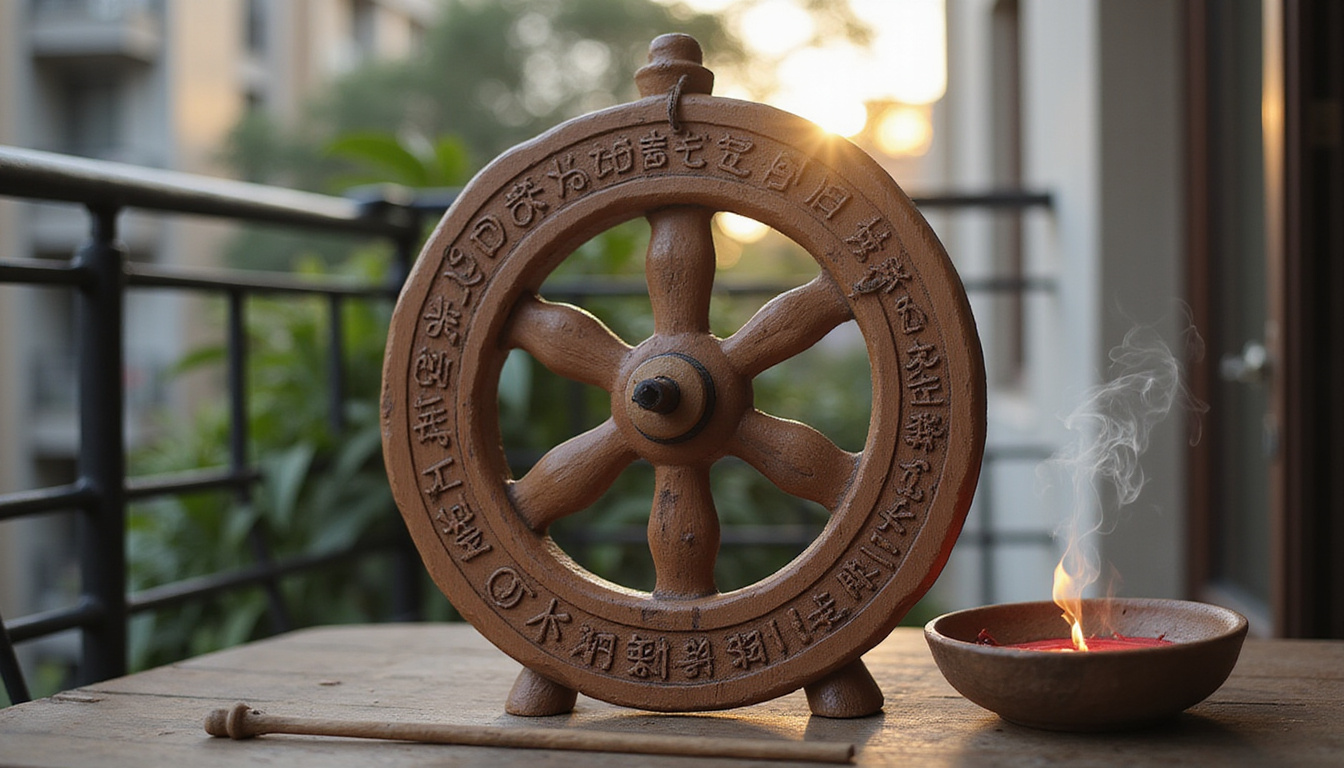
Here are some ways:
-
Morning Check-In
Visualize the Dharma wheel. Choose one spoke (e.g., Right Speech) as your theme for the day. Ask:- How can I embody this in my meetings, messages, and conversations today?
-
Midday Reset
Take 3 mindful breaths. Mentally scan hub, spokes, rim:- Hub: How is my inner state right now? Agitated or steady?
- Spokes: Are my current actions aligned with wisdom, kindness, and integrity?
- Rim: Is there coherence between what I value and what I’m doing?
-
Evening Reflection
Reflect on your day using the eight spokes as prompts. You might journal briefly:- Where did I practice Right View? Where did I miss it?
- What would I like to try differently tomorrow?
-
Conflict Navigation
When in conflict, mentally “spin” the Dharma wheel:- Check your intention.
- Use Right Speech to communicate.
- Apply Right View to understand the other perspective.
- Lean on Right Effort to stay engaged without aggression.
A Simple Dharma Wheel-Inspired Practice
Here is a short, adaptable daily practice based on the Dharma wheel:
-
Sit Quietly (2–5 minutes)
Feel your body and follow your breath. Let your mind settle into the “hub” of stillness. -
Choose One Spoke
Select one aspect of the Eightfold Path for the day (e.g., Right Mindfulness). -
Set a Clear Intention
Form a simple sentence:- “Today, I intend to listen with full attention.”
- “Today, I intend to speak honestly and kindly.”
-
Use an Anchor Reminder
Place a small image of a Dharma wheel, a circle, or even draw one in your notebook. Each time you see it, pause and reconnect with your intention. -
End of Day Review (3–5 minutes)
Ask yourself:- When did I live my intention?
- When did I forget it?
- What did I learn about myself?
This regular “turning” of the Dharma wheel in your daily routine gradually reshapes habits and deepens mindfulness.
Common Misunderstandings About the Dharma Wheel
Because the Dharma wheel is so widely used, it’s easy for its meaning to get diluted. A few clarifications:
-
It’s not just a decorative symbol.
While it appears in art and jewelry, its original purpose is as a teaching and practice tool. -
It’s not about perfection.
The spokes are directions for ongoing practice, not a checklist of moral perfection. The wheel turns precisely because we learn through trial, error, and reflection. -
It isn’t limited to Buddhism.
Non-Buddhists, including people who identify as secular or spiritual-but-not-religious, can use the Dharma wheel framework as a universal guide to clarity, ethics, and mindfulness.
FAQ: Dharma Wheel Symbolism and Practice
1. What does the Dharma wheel symbolize in Buddhism?
The Dharma wheel symbolizes the Buddha’s teachings (Dharma) and the path to liberation. Its hub represents inner stability, the spokes represent elements of the path—commonly the Eightfold Path—and the rim represents mindfulness and integrity that hold everything together.
2. How can I use a Dharmachakra symbol in my own mindfulness practice?
You can use a Dharmachakra image as a visual reminder of your intentions. Place it where you’ll see it often—on your desk, as a phone background, or in a journal. Each time you notice it, pause, take a breath, and ask how you can align one aspect of your behavior (speech, intention, effort, etc.) with greater awareness and kindness.
3. Is there a difference between the Dharma wheel symbol and other Buddhist symbols?
Yes. The Dharma wheel specifically represents the teachings and the path; other symbols carry different meanings (for example, the lotus symbolizes purity emerging from difficulty, and the endless knot symbolizes interdependence). In many contexts, the Dharma wheel is considered one of the most central and foundational symbols of Buddhist practice.
Turning the Dharma Wheel in Your Own Life
You don’t have to adopt new beliefs or labels to let the Dharma wheel transform your daily experience. You can begin with small steps:
- Center yourself in the “hub” with a few conscious breaths each morning.
- Choose one spoke—Right Speech, Right Effort, or Right Mindfulness—and experiment with it for a week.
- Reflect in the evening on how the “rim” of integrity held (or wobbled) throughout your day.
By engaging with the Dharma wheel not just as a symbol, but as a living framework, you create a path toward greater clarity, compassion, and freedom from reactivity.
If you’re ready to deepen your everyday mindfulness, start today: choose one aspect of the Dharma wheel, write down a simple intention, and carry it with you through the next conversation, decision, or challenge. Each small turn of the wheel brings you closer to a life lived with presence and purpose.
Sacred objects often carry deep cultural and spiritual meaning. Learn how these symbols relate to history, spirituality, and the human mind by exploring more articles at SpiritualMindScience.com.