A well-crafted prayer card can be much more than a small printed keepsake. The right prayer card design can comfort grieving families, inspire daily devotion, commemorate a special sacrament, or simply remind someone they’re loved and prayed for. Whether you’re creating memorial cards, wedding or baptism favors, or everyday devotional cards, thoughtful design choices will help your card leave a lasting impression.
Below are practical, creative, and faith-rooted design ideas to guide you from concept to finished piece.
Start with a clear purpose for your prayer card
Before thinking about fonts and colors, clarify why you’re making this prayer card. Your purpose will drive every design decision.
Common purposes include:
- Memorial or funeral prayer cards
- Sacramental cards (baptism, first communion, confirmation, ordination)
- Wedding and anniversary prayer cards
- Feast day and saint devotion cards
- Parish events and retreat keepsakes
- Everyday encouragement or inspirational scripture cards
Ask:
- Who will receive this card?
- When and how will they use it?
- What emotion should they feel when they see it again months or years later?
Once you know the purpose, you can select the size, layout, and visual style that best support your goal.
Choose the right size, shape, and format
The physical format of your prayer card affects how often it’s kept, carried, and noticed.
Popular sizes and formats:
- Wallet-sized (2" x 3.5") – Fits easily into wallets and prayer books; great for memorial and devotional cards.
- Standard postcard (4" x 6") – Offers more space for longer prayers, scripture, or imagery.
- Bookmark-style (2" x 7") – Perfect for Bible or missal use; ideal for parish events, retreats, and gifts.
- Folded mini-card – Allows for a cover image with interior text; good for complex prayers or bilingual content.
Consider:
- Will recipients carry this in a wallet, place it on a nightstand, or keep it inside a Bible?
- Does the prayer text fit cleanly on one side, or do you need front and back?
Design for real-life use: if the card is likely to be handled frequently, choose durable card stock and a protective finish.
Select imagery that speaks to the heart
The image on a prayer card often makes the greatest emotional impact. It should reflect both the spiritual meaning and the person or event it commemorates.
Meaningful imagery ideas
- Christ-centered art – Sacred Heart, Good Shepherd, Divine Mercy, Crucifixion, Resurrection, or Eucharistic imagery.
- Marian devotions – Our Lady of Guadalupe, Our Lady of Fatima, Our Lady of Lourdes, or a simple, tender Madonna and Child image.
- Saint portraits – Ideal for name days, confirmations, and patron saint devotion; consider traditional iconography or respectfully modern illustrations.
- Nature scenes – Sunrises, mountains, oceans, forests, doves, lilies, olive branches, or rays of light—especially for memorial prayer cards.
- Liturgical symbols – Cross, Chi-Rho, Alpha and Omega, fish, lamb, chalice and host, flame (for Confirmation), or water (for Baptism).
If the card honors a loved one, you might use:
- A high-quality portrait photograph
- A candid image that reflects their personality
- A symbolic image (their favorite flower, landscape, or hobby)
Ensure any image you use is high resolution and either your own, licensed, or from the public domain. Many museums and libraries now offer free access to digitized sacred art (for example, The Met’s public domain collection is a helpful starting point – source).
Use color to shape mood and meaning
Color has powerful emotional and symbolic impact on a prayer card.
Color suggestions by purpose:
- Memorial and sympathy: Soft blues, gentle greens, muted purples, warm grays, cream, and light gold accents.
- Baptism and first communion: Whites and ivories with pastel blues or pinks; light gold for a sense of sacred joy.
- Confirmation and Pentecost: Deep reds, oranges, and golds, reflecting the Holy Spirit’s fire.
- Weddings and anniversaries: Elegant neutrals (ivory, champagne, taupe) with accent colors that match the event’s palette.
- Daily inspiration: Calming blues and greens or uplifting sunrise palettes (peach, coral, gold).
Use color purposefully:
- One or two main tones, plus a neutral, keeps the design clean.
- Dark text on a light background is easiest to read.
- Reserve metallic or foil effects for borders, crosses, or names to avoid visual clutter.
Choose fonts that are beautiful and readable
Typography is where many prayer cards succeed or fail. A card can look reverent and professional, or cluttered and hard to read, due largely on font choices.
Guidelines for prayer card fonts:
- Pair two fonts at most – One for headings (e.g., name, title of prayer) and one for body text.
- Use script fonts sparingly – A calligraphy-style font can be beautiful for a name or short phrase, but long passages of script are hard to read.
- Prioritize legibility – Choose clean serif or sans-serif fonts for the main prayer or scripture text.
- Check contrast – Dark text on a light background is best for those with aging eyes or low vision.
Consider the tone:
- Traditional and formal: classic serif fonts and subtle script accents.
- Modern and minimal: clean sans-serif fonts with plenty of white space.
- Vintage devotional: serif fonts with decorative drop caps or small flourishes.
Compose a meaningful, concise text layout
A powerful prayer card often includes surprisingly little text. White space gives room for the eye—and the heart—to rest.
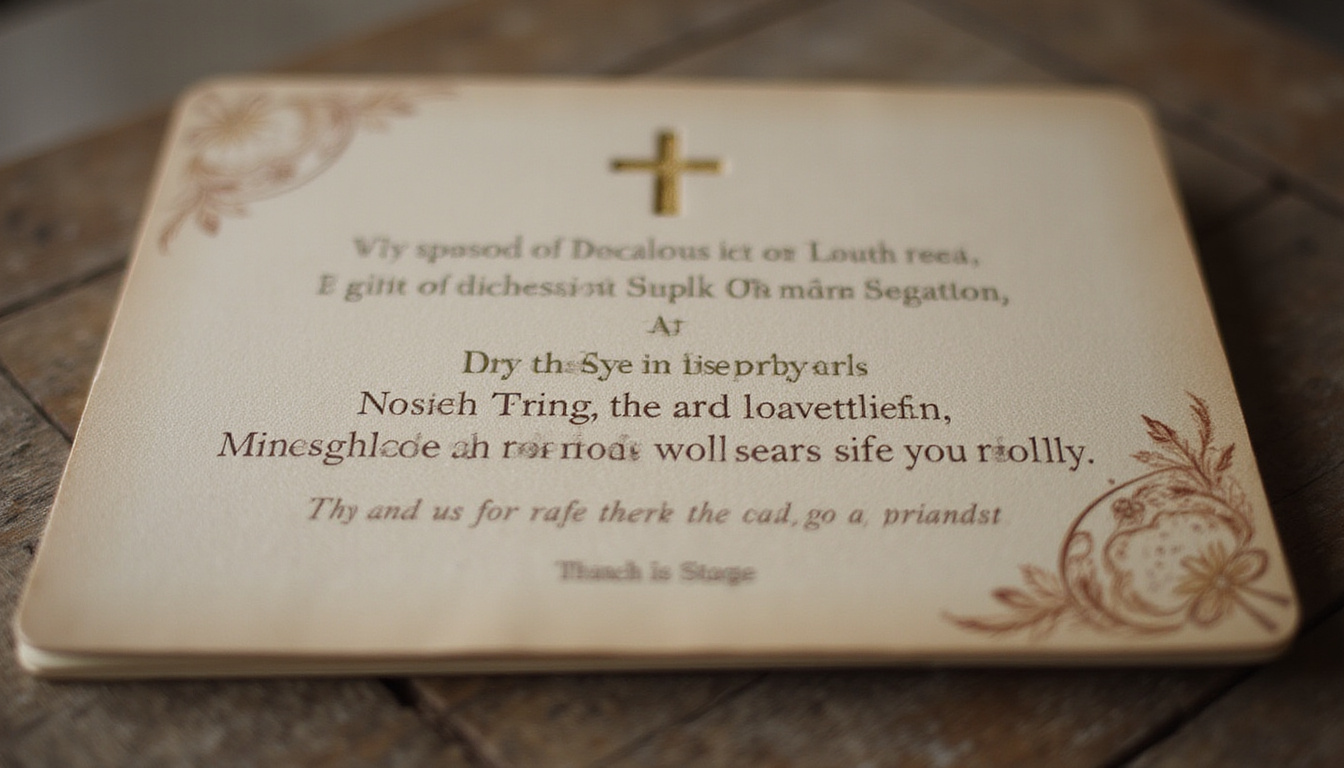
Text elements to consider
- Short scripture passage – Psalm, Gospel verse, or meaningful Old or New Testament text.
- Traditional prayer – Such as the Our Father, Hail Mary, Memorare, Prayer of St. Francis, or a novena excerpt.
- Custom prayer or blessing – Written specifically for the person, event, or occasion.
- Name and dates – For memorial cards or sacramental commemoration.
- Title or theme – “In Loving Memory,” “A Prayer For Peace,” “On Your Baptism Day.”
When arranging text:
- Lead with the person’s name or the card’s title.
- Present longer prayers in short paragraphs or line breaks for easier reading.
- Avoid placing text directly over busy images; use subtle overlays or solid areas for readability.
Creative prayer card ideas by occasion
To spark inspiration, here are specific, impactful design approaches for different uses.
Memorial prayer cards
- Front: Soft nature scene or reverent sacred image; the person’s name in an elegant script; dates in a simple serif.
- Back: A short, comforting scripture (e.g., Psalm 23, John 14:1–3) and a prayer for the deceased’s soul.
- Optional: A brief quote the person loved, or a single-line remembrance such as “Forever in our hearts.”
Wedding and anniversary prayer cards
- Front: Photo of the couple or a symbolic image (intertwined rings, cross, or lilies); their names and wedding date.
- Back: A prayer for the couple’s marriage, a scripture on love (e.g., 1 Corinthians 13, Colossians 3:14), or a personalized blessing for guests to keep.
Baptism, First Communion, and Confirmation
- Baptism: Soft, light colors; water or dove imagery; child’s name and date; a parent’s blessing or Baptism-specific prayer.
- First Communion: Chalice and host or wheat and grapes; a short Eucharistic prayer or verse (“I am the bread of life…”).
- Confirmation: Flames, dove, or bishop’s crozier; confirmation name and date; a Holy Spirit prayer.
Everyday devotional or encouragement cards
- Minimalist front with a single powerful word: “Peace,” “Hope,” “Courage,” “Trust.”
- Back with a matching scripture and a brief prayer, such as “A Prayer When You Feel Anxious” or “A Morning Offering.”
Add personal touches that make it unforgettable
Small, thoughtful details can transform a simple prayer card into a treasured keepsake.
Ideas for personalizing:
- Handwritten element – Scan a loved one’s signature or a short phrase from their handwriting.
- Favorite quote – From a saint, spiritual writer, hymn, or even the person being remembered.
- Local imagery – A parish church, hometown landscape, or a meaningful landmark.
- Bilingual or multicultural design – Especially meaningful for families or congregations who pray in more than one language.
- Back-of-card note – “With love from the [Family Name] family” or “Prepared by St. [Name] Parish Youth Ministry.”
Such details can make your prayer card feel truly unique and deeply connected to those who receive it.
Print finishes and materials that elevate your design
The tactile feel of a prayer card influences how people perceive and keep it.
Printing and finish options:
- Matte finish – Soft, non-reflective, easy to read; ideal for a subdued, classical look.
- Gloss finish – Enhances images and colors; good for photo-heavy designs.
- Soft-touch or velvet lamination – Adds a luxurious feel and increases durability.
- Rounded corners – Prevents bending and fraying; gives a refined, finished look.
- Foil stamping or metallic ink – Highlights crosses, names, or borders without overpowering the design.
Choose a card stock that is thick enough to feel substantial but not so thick it won’t slide easily into a Bible or wallet.
Common prayer card design mistakes to avoid
Keeping a few pitfalls in mind will help ensure your prayer card design remains timeless and reverent.
- Overcrowding with text – Long paragraphs and multiple prayers can be visually overwhelming.
- Too many fonts and colors – Stick to a restrained palette for a cohesive, peaceful feel.
- Low-quality images – Blurry or pixelated photos distract from the card’s message.
- Poor contrast – Light text on light backgrounds, or decorative fonts in tiny sizes, can make the prayer unreadable.
- Clashing symbols – Combine visual elements that make theological and aesthetic sense together.
Aim for simplicity, clarity, and reverence over complexity.
Simple planning checklist for your prayer card
Use this quick list to organize your design process:
- Define the purpose and audience.
- Decide on size and orientation (vertical or horizontal).
- Select a main image or artwork.
- Choose a color palette that supports the theme.
- Pick two complementary fonts (heading + body).
- Gather your text: name, dates, scripture, prayer.
- Plan front vs. back content.
- Add personal touches or symbols.
- Choose card stock, finish, and print details.
- Review a proof for spelling, image quality, and readability.
FAQ about prayer card design
1. What should I include on a memorial prayer card?
Include the full name of the deceased, birth and death dates, a meaningful image, a short scripture or quote, and a concise memorial prayer. Many memorial cards also add “In Loving Memory” or a brief line of tribute.
2. How do I choose the right prayer card size for my needs?
If you want people to carry it daily, choose a wallet-sized or bookmark-style card. For longer prayers or bilingual text, consider a larger or folded prayer card so the design stays uncluttered and easy to read.
3. Can I design my own Catholic prayer cards at home?
Yes. Many people create their own Catholic prayer card designs using basic design software or online templates, then print through a professional printer. Just ensure images are high resolution, prayers are accurately reproduced, and fonts remain legible at small sizes.
A meaningful prayer card can become a cherished reminder of faith, love, and hope that endures long after an event ends or a service concludes. By choosing intentional imagery, thoughtful typography, and a clear, heartfelt message, you can design a card that truly leaves a lasting impression.
If you’re ready to turn your ideas into a beautiful finished piece, gather your favorite prayer, a meaningful image, and the details you want to honor—and start designing your prayer card today. Share it with your family, parish, or community, and let this small, sacred keepsake carry encouragement and grace wherever it goes.
Sacred objects often carry deep cultural and spiritual meaning. Learn how these symbols relate to history, spirituality, and the human mind by exploring more articles at SpiritualMindScience.com.