The Ark of the Covenant has fascinated scholars, theologians, adventurers, and conspiracy theorists for centuries. Described in the Hebrew Bible as the sacred chest that housed the stone tablets of the Ten Commandments, it has been lost to history for more than 2,500 years. Yet the mystery hasn’t faded. In fact, new archaeological data, re-examinations of ancient texts, and modern technologies are shedding fresh light on where the Ark might be—and why it still matters.
In this article, we’ll explore the historical background of the Ark, trace the last known references to it, examine leading location theories, and highlight subtle “hidden clues” that could refine the search.
What Was the Ark of the Covenant?
Before asking where the Ark might be, it’s essential to understand what it was and why it was so important.
According to the Book of Exodus, the Ark of the Covenant was:
- A gold-covered wooden chest, around 2.5 cubits long, 1.5 cubits wide, and 1.5 cubits high
- Topped with a “mercy seat” and two golden cherubim
- Constructed at God’s command to house the tablets of the Law received by Moses on Mount Sinai
The Ark functioned as:
- A tangible symbol of God’s presence among the Israelites
- A central object in religious rituals and atonement rites
- A focal point in the Tabernacle and later in the First Temple in Jerusalem
The Ark’s theological importance helps explain why its disappearance is one of the greatest unsolved mysteries in biblical history.
The Last Clear Mentions of the Ark in the Bible
One challenge in tracing the Ark of the Covenant is that the Bible’s narrative about it ends somewhat abruptly. Studying the last explicit mentions provides key clues.
The Ark in Solomon’s Temple
The Ark was placed in the Holy of Holies in Solomon’s Temple in Jerusalem (1 Kings 8; 2 Chronicles 5). This was the spiritual center of ancient Israel:
- Only the high priest could enter the Holy of Holies
- The Ark represented the covenant between God and Israel
- The Temple became the only legitimate place for sacrifices and pilgrimage
The Silent Gap
After its installation in Solomon’s Temple, the Ark of the Covenant is rarely mentioned in later biblical books. By the time of King Josiah (late 7th century BCE), 2 Chronicles 35:3 suggests it was still known, but that passage itself is debated among scholars.
After the Babylonian conquest (586 BCE) and destruction of the First Temple, the text notably does not describe the Ark being captured, destroyed, or carried off—an omission that fuels many theories.
Did the Ark Disappear Before or During the Babylonian Invasion?
A crucial “hidden clue” in the mystery lies in the timeline of Jerusalem’s fall.
Lack of Babylonian Inventory
The Babylonians kept relatively detailed records of temple plunder from conquered cities. Biblical accounts list many temple items seized from Jerusalem, yet the Ark of the Covenant is not specifically named among them (2 Kings 24–25, Jeremiah 52). This absence suggests:
- The Ark might have been removed before the final siege
- It could have been hidden or destroyed internally
- Or the tradition that it was already gone was so strong that later writers simply assumed its absence
Jeremiah and the Prophetic Silence
The prophet Jeremiah, active during the last days of Judah, references the Ark in a future-oriented way, saying the time will come when people will no longer speak of it or remember it (Jeremiah 3:16). Some interpret this as evidence that the Ark was already missing or at risk, even before Jerusalem fell.
Leading Theories on the Ark’s Possible Location
Over the centuries, numerous theories have emerged about the Ark’s fate. While none have been conclusively proven, several stand out for their coherence and supporting clues.
1. Hidden Beneath the Temple Mount in Jerusalem
One of the most prominent theories claims that the Ark of the Covenant remains hidden somewhere under the present-day Temple Mount.
Why this theory persists:
- Rabbinic traditions (such as in the Talmud and later writings) suggest that King Josiah ordered sacred items, possibly including the Ark, to be concealed in chambers beneath the Temple.
- The Temple Mount area has extensive underground spaces, some known, others still unexplored due to religious and political sensitivities.
- Limited archaeological access makes it plausible that a hidden chamber could remain undiscovered.
Challenges:
- The Temple Mount is one of the most sensitive religious sites on earth. Systematic excavation is nearly impossible under current conditions.
- Many underground features have already been disturbed by earlier building projects across centuries.
Still, the combination of Jewish tradition and unexplored substructures keeps this theory among the strongest in the scholarly community.
2. The Ark in Ethiopia: The Church of Our Lady Mary of Zion
Another highly publicized theory places the Ark of the Covenant in Aksum, Ethiopia, at the Church of Our Lady Mary of Zion.
The Ethiopian tradition claims:
- The Ark was brought to Ethiopia by Menelik I, the (legendary) son of King Solomon and the Queen of Sheba.
- It has been guarded for centuries by a single appointed monk who never leaves the church grounds.
- What visitors can see today is not the Ark itself but a copy, while the original is kept in a sanctuary where only the guardian is allowed.
Supporting clues:
- Ethiopia’s ancient Christian community preserves a deep, continuous tradition about the Ark’s presence.
- The Ethiopian Orthodox Tewahedo Church uses replicas of the Ark, called tabots, in every church, highlighting the centrality of the Ark in Ethiopian religious practice.
- Some historians highlight trade and political links between ancient Israel and the Horn of Africa, which may have transmitted Ark-related traditions to Ethiopia (source: British Museum – Ethiopia and the Ark).
Limitations:
- No independent scientific verification has been allowed.
- The historical timeline is difficult to reconcile perfectly with biblical chronology.
Nonetheless, the Ethiopian claim remains one of the few living traditions asserting that the Ark of the Covenant is physically present in a known location today.
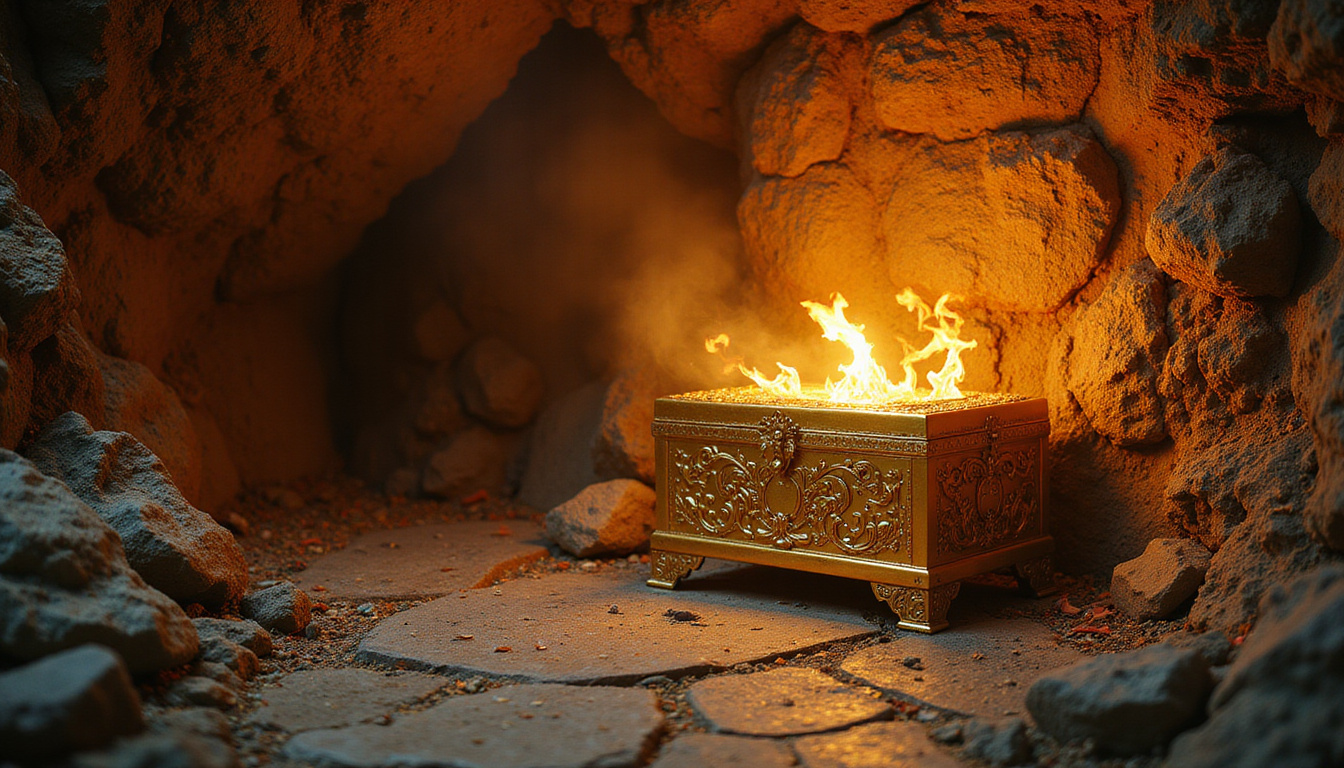
3. The Ark Hidden in Qumran Caves or the Judean Desert
The discovery of the Dead Sea Scrolls in the mid-20th century showed that the Judean Desert was a major hiding place for sacred texts and treasures.
Key clues:
- Some fringe interpretations of the Copper Scroll—one of the Dead Sea Scrolls—argue it may reference hidden Temple treasures, possibly even the Ark.
- The rugged terrain and numerous caves around Qumran and the Dead Sea would have been ideal for hiding valuables during times of crisis.
Obstacles:
- Most archaeologists are cautious: the Copper Scroll likely lists precious metals, not cultic objects like the Ark.
- Extensive exploration has yet to uncover anything resembling the biblical Ark.
Still, the precedent of hiding valuable religious items in desert caves keeps this theory alive, especially in popular discussions.
4. The Ark in a Forgotten Cave or Chamber Near Jerusalem
Closely related to the Temple Mount theory is the idea that the Ark was hidden nearby, but not directly under the Temple.
Possible locations include:
- A natural cave system in the Judean hills
- A deliberately cut rock chamber somewhere in the City of David
- An underground passage leading from the Temple area to a secure hiding place
Some late Jewish traditions mention priests hiding sacred items in caves as the Babylonian army approached. While details are scant, the concept fits the broader historical context: when a city is about to fall, valuable religious objects are often hidden, not surrendered.
5. The Ark Was Destroyed or Lost Irretrievably
Not all scholars believe the Ark of the Covenant survived antiquity.
Arguments for its destruction include:
- The intensity of the Babylonian siege and the destruction of the First Temple make it plausible that the Ark was smashed, burned, or dismantled.
- Wood overlaid with gold would have been a tempting target for plunder and repurposing.
- Total loss of countless ancient religious artifacts is the norm, not the exception, across history.
In this view, the silence of the biblical record may not be a clue to survival, but simply the result of theological discomfort with acknowledging that such a sacred object was destroyed.
“Hidden Clues” Scholars Use to Narrow the Search
While there is no universally accepted solution, researchers rely on several subtle types of evidence when evaluating Ark of the Covenant location theories.
1. Textual Cross-Referencing
Biblical, apocryphal, and rabbinic texts are compared to identify small anomalies:
- Sudden shifts in narrative focus around the Temple period
- Phrases suggesting removal or concealment
- Later interpretations by Jewish and early Christian writers
Even brief mentions can help reconstruct a plausible timeline of the Ark’s final days.
2. Archaeological Patterns
Archaeologists look not just for the Ark itself, but for patterns that support or undermine theories:
- Evidence of last-minute construction or modifications under or near the Temple Mount
- Signs of emergency use of caves around Jerusalem during the Babylonian period
- Comparative studies of how other ancient cultures protected their sacred objects in times of crisis
These broader patterns can make certain theories more likely than others.
3. Continuity of Tradition
Living traditions, such as the Ethiopian claim, are studied for:
- Internal consistency over centuries
- Connection to known historical events
- How and when the tradition first appears in written sources
While tradition is not proof, strong and early traditions can be valuable clues to where and how certain beliefs about the Ark of the Covenant arose.
Why the Ark’s Location Still Captivates Us
The ongoing fascination with the Ark isn’t only about archaeology. It touches deeper human themes:
- Identity and memory – For the Jewish people, the Ark is intertwined with covenant, law, and nationhood.
- Faith and presence – For many believers, it symbolizes God’s tangible presence with humanity.
- Mystery and discovery – For others, the Ark represents the allure of lost history and the possibility that something of immense significance is still hidden, waiting to be found.
Regardless of whether the Ark lies under the Temple Mount, in Ethiopia, in a desert cave, or is lost forever, the search itself fuels questions about history, belief, and the limits of human knowledge.
FAQ: Common Questions About the Ark of the Covenant
1. What happened to the Ark of the Covenant historically?
Historically, the Ark of the Covenant is last clearly placed in Solomon’s Temple in Jerusalem. After the Babylonian destruction of the Temple in 586 BCE, the biblical record goes silent about its fate. Various theories suggest it was hidden, taken, or destroyed, but no single explanation has been definitively proven.
2. Where is the Ark of the Covenant now, according to different traditions?
Different traditions offer different answers:
- Jewish traditions often hint at the Ark hidden under or near the former Temple in Jerusalem.
- Ethiopian tradition claims the Ark rests in Aksum at the Church of Our Lady Mary of Zion.
- Some modern theories suggest the Ark of the Covenant could be in desert caves, lost in war, or destroyed long ago.
3. Has anyone found the Ark of the Covenant?
No verified discovery has been recognized by the scholarly or archaeological community. Many claims have surfaced over the years, but none have produced publicly verifiable evidence that withstands professional scrutiny.
The mystery of the Ark of the Covenant stands at the crossroads of faith, history, and adventure. Each new manuscript fragment, archaeological survey, or technological advance has the potential to refine our understanding—or even reveal a long-hidden chamber or forgotten artifact. If you’re intrigued by the possibility that decisive clues may still be buried in texts, in the ground, or in living traditions, now is the time to dive deeper. Explore reputable archaeological studies, examine ancient sources for yourself, and stay informed about new discoveries. The next breakthrough in the search for the Ark’s true fate might emerge from the very questions you choose to pursue today.
Sacred objects often carry deep cultural and spiritual meaning. Learn how these symbols relate to history, spirituality, and the human mind by exploring more articles at SpiritualMindScience.com.