Syncretism is all around us—whenever cultures meet, trade, migrate, or even clash, ideas begin to mix. At its core, syncretism is the blending of beliefs, practices, and symbols from different traditions into something new. You can see it in religions, festivals, language, art, and even everyday customs, often without realizing it.
This article unpacks what syncretism is, why it happens, how it works in different parts of culture, and what debates surround it today.
What Is Syncretism?
In its simplest form, syncretism means the combining of elements from different belief systems or cultures. It often refers to religion, but the concept applies to philosophy, art, politics, and social customs as well.
Key aspects of syncretism:
- It is intentional or organic: People may consciously adopt elements from another culture, or blending might happen gradually over generations.
- It can be peaceful or conflict-driven: Mixing may result from coexistence, conversion, colonization, or resistance.
- It is creative, not merely additive: Syncretic traditions usually transform what they adopt, producing new meanings and practices.
Scholars of religion and anthropology have long studied syncretism to understand how cultural change really happens on the ground, beyond official doctrines and laws (source: Encyclopedia Britannica).
Why Syncretism Happens: Core Drivers of Cultural Blending
Syncretism is not random. It tends to emerge under particular conditions where people and ideas meet. Some of the main drivers include:
1. Migration and Diaspora
When people move—through trade, work, or forced migration—they bring their beliefs and practices with them. Living in new environments, they adapt traditions and combine them with local customs.
- Immigrant communities might keep core rituals, but celebrate them with local foods, languages, or calendar dates.
- Over time, children and grandchildren blend “old country” traditions with those of the host society.
2. Trade and Intercultural Contact
Historical trade routes like the Silk Road or Indian Ocean networks connected distant societies. Merchants exchanged not only goods, but stories, religious ideas, and artistic styles.
- Gods and saints were identified with each other across cultures.
- Artistic symbols, motifs, and temple designs crossed borders and were reinterpreted.
3. Conquest, Empire, and Colonization
When empires expand, they rarely wipe the slate clean. Conquerors often adapt local gods and rituals, incorporating them into an imperial framework.
- The Roman Empire, for example, frequently equated local deities with Roman ones.
- Colonized peoples have also blended imposed religions with older traditions as a strategy of cultural survival.
4. Missionary Work and Conversion
Missionaries introducing a new religion may adapt messages and practices to fit existing cultural frameworks:
- Translating sacred texts into local languages.
- Re-using sacred sites or festivals, redefining their meaning but keeping familiar forms.
Converts themselves are active agents in syncretism. They negotiate between new teachings and inherited worldviews, often keeping earlier practices in transformed ways.
Religious Syncretism: Blended Belief in Practice
Religious syncretism is the most commonly discussed form, because religion often carries a concentrated mix of symbols, ethics, and community identity. It shows how people reconcile different spiritual systems in real life.
African Diaspora Religions
In the Americas, enslaved Africans brought diverse religious traditions that met European Christianity and Indigenous beliefs. Under harsh conditions, syncretism became both a survival strategy and a creative spiritual response.
Examples include:
- Santería (Cuba): Yoruba deities (Orishas) are associated with Catholic saints, often sharing feast days and iconography.
- Candomblé (Brazil) and Vodou (Haiti): Blend West and Central African traditions, Catholicism, and local Indigenous influences.
Here, syncretism allowed people to maintain older spiritual ties under the outward cover of an imposed religion.
Greco-Roman and Ancient Mediterranean Worlds
The ancient Mediterranean was a hotspot of religious syncretism:
- Greek and Egyptian traditions combined in cults like that of Serapis, a deity created under the Ptolemies to unify Greek and Egyptian subjects.
- Local gods across the empire were identified with Zeus, Jupiter, or other major deities, creating hybrid religious landscapes.
These blends helped political rulers stabilize diverse societies by showing respect—at least symbolically—for local traditions.
East and Southeast Asian Religious Blending
In many East and Southeast Asian contexts, syncretism is normalized rather than controversial:
- In Japan, Shinto and Buddhism have coexisted and intermingled for centuries; many shrines and temples share spaces and rituals.
- In China, elements of Confucianism, Daoism, and Buddhism often coexist in the same person’s practice and worldview.
Instead of mutually exclusive identities, people combine traditions according to occasion and need—ancestor rites, ethics, meditation, and healing.
Cultural Syncretism Beyond Religion
Syncretism is not only about gods and rituals. It affects language, art, music, food, and everyday life.
Language and Expression
Languages borrow words, idioms, and even grammatical constructions from one another. Over time, this produces syncretic forms:
- Creole languages emerged in colonial contexts, combining vocabulary and structures from European and African or Indigenous languages.
- Everyday speech in multicultural cities mixes slang and expressions from multiple linguistic traditions.
These linguistic blends reflect lived cultural mixing and power dynamics.
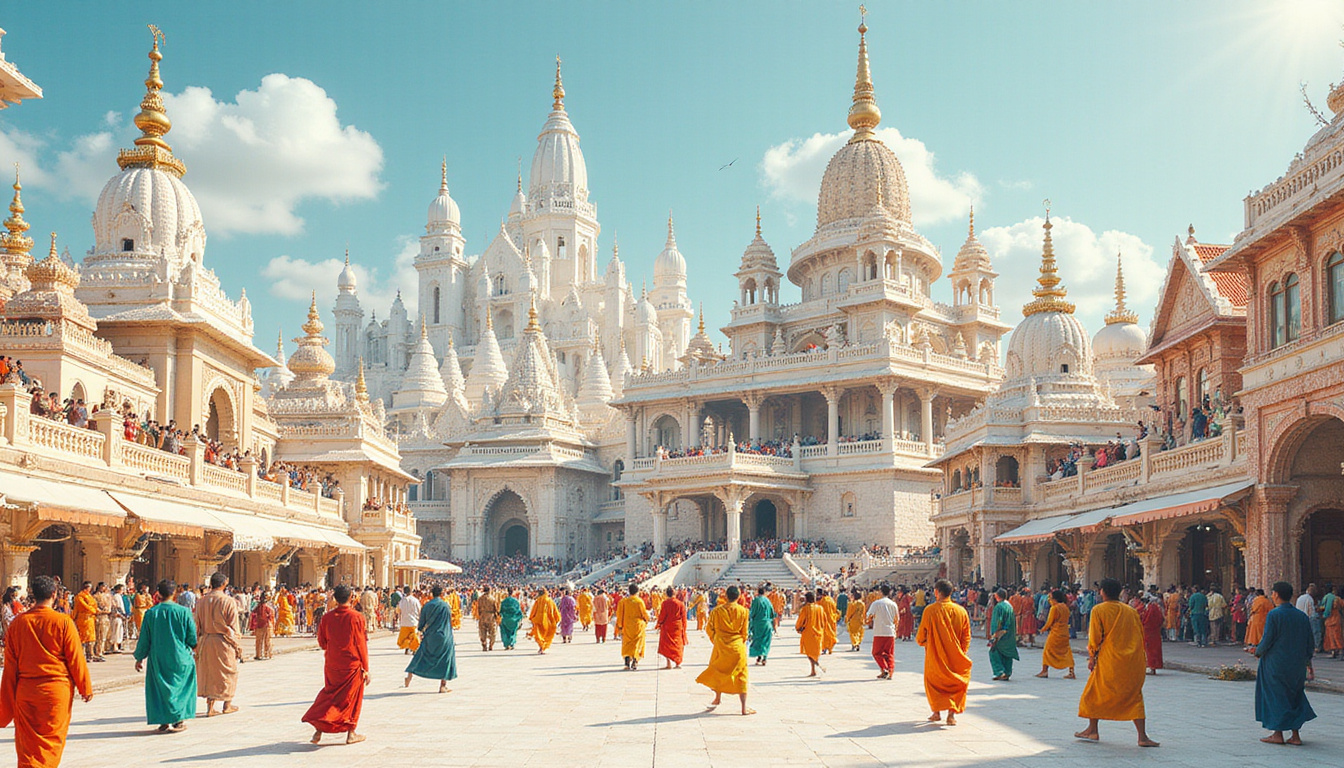
Art, Architecture, and Symbolism
Visual culture often makes syncretism visible:
- Gothic churches built over earlier sacred sites that retain pre-Christian layouts or motifs.
- Colonial-era churches in Latin America that incorporate Indigenous symbols and patterns into Christian iconography.
- Modern religious art that depicts spiritual figures in local clothing or environments.
Symbols can be re-used with new meanings, or layered: one image speaking to different audiences simultaneously.
Festivals and Rituals
Many popular festivals are syncretic:
- Winter and spring holidays in Europe and North America combine older seasonal and agricultural traditions with Christian narratives.
- Harvest festivals around the world often merge Indigenous, religious, and national elements.
- National holidays sometimes overlay political meanings onto older religious or seasonal observances.
Syncretism here helps traditions stay relevant, connecting past and present.
How Syncretism Works: Mechanisms of Blending
Syncretism doesn’t just mash things together. It follows recognizable patterns. Common mechanisms include:
-
Identification of Figures
A deity, saint, or spiritual figure from one system is equated with one from another based on similar roles, attributes, or stories. -
Reinterpretation of Symbols
Existing symbols (like the sun, water, or animals) are given new meanings or layered with additional significance. -
Reframing Rituals
A ritual may keep its structure (dates, actions, songs) but be explained with new theology or cultural narratives. -
Hybrid Practices
Elements of two or more traditions are combined in a single event: a ceremony might follow one form but use another tradition’s language, music, or dress. -
Contextualization
New beliefs are expressed in terms that resonate with local cosmologies or moral systems, making them feel “at home.”
Through these processes, syncretism creates practices that feel familiar yet renewed, allowing communities to adapt without feeling they have completely abandoned their past.
Debates Around Syncretism: Authenticity, Power, and Identity
Although syncretism is common, it is often controversial. Different groups interpret blending in sharply contrasting ways.
Authenticity vs. Adaptation
Some religious authorities or cultural leaders see syncretism as:
- A distortion of “pure” doctrine or tradition.
- A threat to group identity or spiritual integrity.
Others argue that:
- All traditions are historically shaped by contact and borrowing.
- Adaptation is necessary for survival and relevance in changing contexts.
From this viewpoint, syncretism is not corruption, but the normal process of living cultures.
Power and Inequality
Syncretism often occurs under conditions of unequal power: colonization, slavery, or economic domination. This raises questions:
- Are practices genuinely shared, or imposed by stronger groups?
- Does calling something “syncretic” sometimes mask histories of violence or forced conversion?
In response, many scholars and communities emphasize:
- The agency of marginalized groups who creatively reshape imposed elements rather than passively accepting them.
- The need to recognize how syncretism can preserve suppressed traditions in disguised or coded ways.
Identity and Boundary-Making
Ironically, syncretism both blurs and reinforces boundaries:
- Blending can create shared spaces and hybrid identities.
- But accusations of syncretism are sometimes used to police boundaries—labeling others as “impure” or “incorrect.”
Understanding syncretism means recognizing that identities are often negotiated, not fixed, even when people claim ancient or unchanging roots.
Recognizing Syncretism in Everyday Life
You likely encounter syncretism regularly. Look for situations where:
- Two or more traditions share the same space, festival, or practice.
- People explain the “same” ritual differently depending on their background.
- Artistic works incorporate motifs or styles from distinct cultures.
- Religious buildings or sacred spaces show architectural layering from different eras and faiths.
Syncretism is not just a historical curiosity; it continues wherever societies intersect—online, in migration, in interfaith families, and in global media.
Summary: Key Points About Syncretism
To pull the threads together, here are the main things to remember about syncretism:
- It is the blending of beliefs, practices, and symbols from different traditions.
- It emerges through migration, trade, conquest, colonization, and everyday contact.
- Religious syncretism is highly visible, but the concept applies just as much to language, art, and social customs.
- Mechanisms include identifying deities, reinterpreting symbols, reframing rituals, and creating hybrids.
- Syncretism can be celebrated as creative adaptation or criticized as corruption, often reflecting deeper struggles over power and identity.
- It is a normal and ongoing feature of cultural life, not just an odd exception.
FAQ on Syncretism and Related Concepts
Q1: What is religious syncretism in simple terms?
Religious syncretism is when elements from different religions—such as gods, rituals, holidays, or symbols—are combined into a new or modified system of belief and practice. This might look like worshipping an older deity under the image of a newer religion’s saint, or celebrating one religion’s festival using another culture’s customs.
Q2: How does cultural syncretism differ from religious syncretism?
Cultural syncretism is broader. It includes the blending of languages, art styles, music, clothing, food, and social customs, while religious syncretism focuses specifically on spiritual beliefs and practices. Religious syncretism is one important type of cultural syncretism, but not the only one.
Q3: Is syncretic religion less “authentic” than non-syncretic religion?
From a historical and scholarly perspective, almost all religious traditions have been shaped by contact and borrowing, making syncretic elements nearly universal. Whether syncretic religion is viewed as less authentic depends on theological and cultural judgments. Many practitioners see syncretism as a faithful adaptation of timeless truths to new contexts, rather than a dilution.
Across history and into the present, syncretism shows how human beings respond to difference: not only by resisting or separating, but by listening, translating, and creating new forms together. If you’re interested in understanding the real complexity of cultures and religions—not just their official stories—pay attention to where worlds overlap.
If you’d like to explore syncretism in a specific region, religious tradition, or cultural practice—whether for research, teaching, or personal curiosity—share your area of interest, and I can help you map out concrete examples, reading lists, and discussion questions tailored to your needs.
Cultural superstitions have shaped traditions and beliefs for generations. Explore the psychology, cultural history, and science behind these fascinating practices at SpiritualMindScience.com.