If you’ve ever been captivated by an ornate chalice behind a glass case or at an antique market, you’re not alone. These ceremonial cups carry centuries of history, artistry, and spiritual meaning. But the growing demand for antique chalices has also attracted a wave of reproductions and outright fakes. This guide walks you through how to evaluate a chalice with confidence so you can spot authentic antiques, avoid costly mistakes, and build a collection you’re proud of.
Why Antique Chalices Are So Collectible
Chalices sit at the intersection of art, religion, and social history. Collectors are drawn to them for several reasons:
- Religious and ritual significance – Often linked to Christian Eucharistic rituals, but also to other ceremonial traditions.
- Artistic craftsmanship – From simple hammered silver cups to jewel-encrusted Gothic masterpieces.
- Historical context – Many chalices are tied to a specific period, region, or church.
Because of this mix of value types (spiritual, historical, artistic, and monetary), the market for vintage and antique chalices is both rich and complex—and that’s exactly why fakes can be so convincing.
Understand What Makes a Chalice “Antique”
Before you can judge authenticity, clarify your terminology:
- Antique chalice – Typically 100 years old or more.
- Vintage chalice – Often 20–99 years old, not necessarily of high value.
- Reproduction – A modern piece intentionally copying an older style.
- Fake/forgery – A piece made or altered to deceive buyers into believing it’s older or more valuable than it is.
Many churches and private collectors also use high-quality modern chalices, which are perfectly legitimate but not “antique” in the collector’s sense.
Step 1: Study Common Historical Styles
Recognizing the broad style of a chalice is your first line of defense against fakes. Here are core historical categories:
Medieval and Gothic Chalices (c. 12th–15th centuries)
- Deep cups, often conical or tulip-shaped.
- Knobs (nodes) at the stem for a secure grip.
- Heavy use of religious iconography and enamel work.
- Base often has lobes or a six/eight-sided design.
Genuine medieval chalices are rare and very expensive. If you find one at a flea market for a few hundred dollars, assume you’re holding a reproduction until proven otherwise.
Renaissance and Baroque Chalices (c. 16th–18th centuries)
- More ornate than earlier styles.
- Rich scrollwork, putti (cherubs), and elaborate engraving.
- Cup and base may be heavily decorated; stems can be twisted or baluster-shaped.
19th-Century Revival Styles
- Neo-Gothic and Neo-Baroque chalices imitate earlier periods.
- Often very high quality, but decorative details may be sharper and more “perfect” due to improved tools.
- Frequently used in Catholic churches during the Gothic Revival.
20th-Century and Contemporary Chalices
- A wide range: from simple modernist silver to heavily ornate “traditional” designs.
- Sometimes incorporate non-traditional materials (stainless steel, plated alloys).
Understanding style periods won’t confirm authenticity on its own, but it helps you spot anachronisms—for example, a “medieval” chalice with clearly 20th-century machine engraving is a red flag.
Step 2: Examine Materials and Construction
Authentic antique chalices were typically made to last generations. Look closely at:
Metals
Common metals for older chalices include:
- Solid silver (often sterling or continental silver)
- Gilded silver – silver with a thin layer of gold (vermeil)
- Gold (rare and usually associated with high ecclesiastical use)
- Copper alloys (bronze or brass), sometimes gold-plated
Warning signs of a fake or low-quality reproduction:
- Very light weight relative to size (suggests thin alloy or pot metal).
- Flaking, uneven plating revealing a cheap base metal.
- Bright, mirror-finish “gold” that looks like costume jewelry.
Construction Methods
Antique chalices were often:
- Hand-forged and hand-turned for the stem and base.
- Hand-engraved or chased for decoration.
- Assembled from multiple parts soldered together.
Look for:
- Slight irregularities in symmetry (a good sign of handwork).
- Visible solder lines where elements meet (normal in older pieces).
- Tool marks inside the cup or underneath the base.
By contrast, many modern fakes are cast as one piece or in large components. Casting seams, repeated decorative motifs (identical faces or patterns), and lack of tool marks all point to mass production.
Step 3: Read the Hallmarks and Maker’s Marks
One of the most reliable ways to assess a chalice is by its marks, when present.
Types of Marks to Look For
- Hallmarks – Official stamps indicating metal purity and often the assay office and date (common in European silver).
- Maker’s marks – The silversmith’s or manufacturer’s stamp.
- Religious or institutional marks – Marks from church workshops, dioceses, or religious orders.
- Import/export marks – Especially in the 19th–20th centuries.
Where to look:
- Underside of the base
- Near the rim of the foot
- On the stem node
- Inside the cup (less common but possible)
Red Flags in Markings
- Marks that are poorly struck, blurry, or inconsistent with the supposed country/period.
- Modern fonts on allegedly old marks.
- “925” stamped alone on a chalice claimed to be 18th century (that style of stamp is typically 20th century onward).
- Generic “silver plate” stamps on a piece sold as solid silver.
Use hallmark guides or online databases from national assay offices to verify marks. For example, many European countries have documentation of historic silver marks you can search (source: The Victoria and Albert Museum collection and resources).
Step 4: Assess Patina, Wear, and Repairs
Authentic antique chalices usually show age in specific, logical ways.
Natural Aging Signs
- Patina – A soft, uneven luster on silver or gilt surfaces.
- Wear on contact points – The rim of the cup, the knob where it’s held, and the outer edge of the base.
- Fine surface scratches from handling, cleaning, and storage.
Look for consistency: wear should appear where you’d naturally grasp the chalice or where cloths and lips would touch.
Red Flags in Aging
- Uniform “antique” finish with no variation—often an artificially applied patina.
- Heavy wear on unlikely areas (e.g., deeply recessed decorative details but not on raised surfaces).
- Fresh-looking engraving on an otherwise worn piece (may indicate later personalization or deceptive alterations).
- Obvious modern repairs (bright new solder, misaligned parts) on an allegedly untouched antique.
Repairs aren’t necessarily bad; many antique chalices were repaired in their working lives. But they should be disclosed and factored into price.
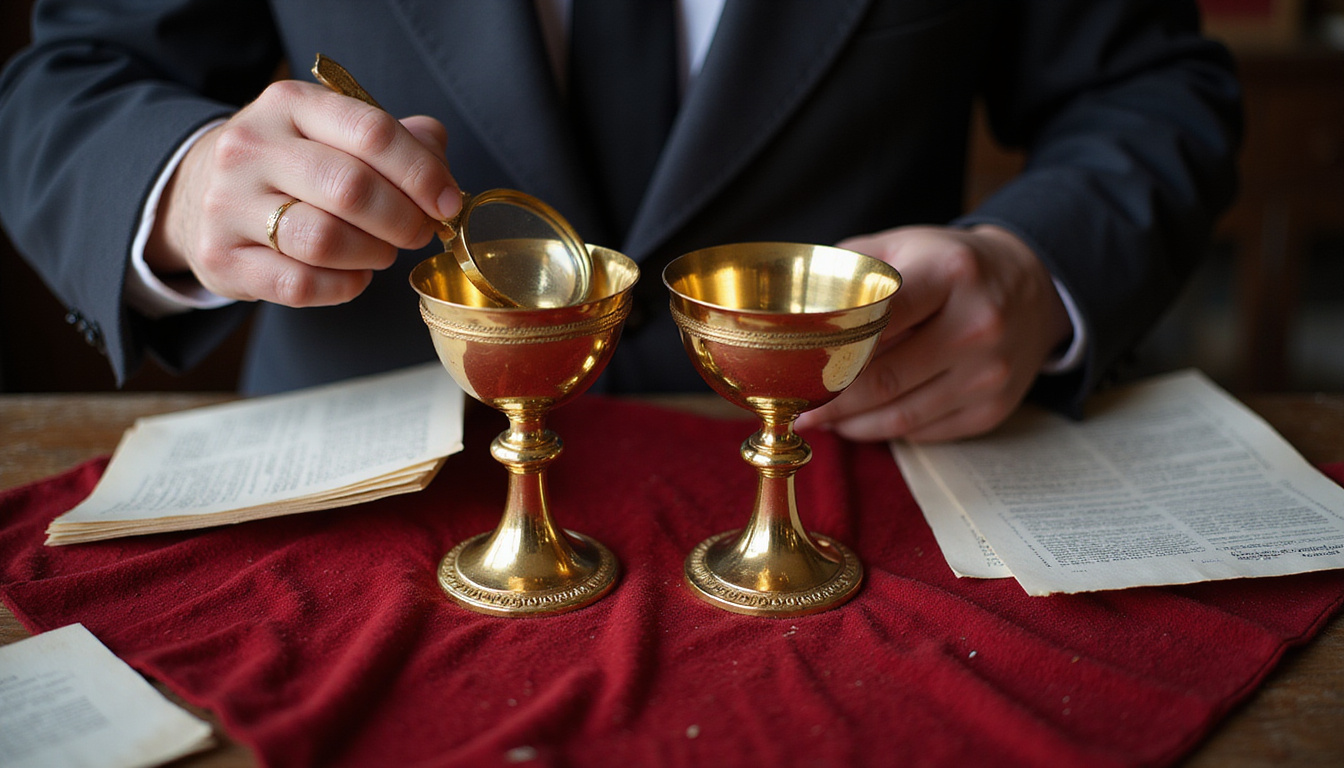
Step 5: Learn Common Types of Fake or Misrepresented Chalices
Not every mislabelled chalice is an intentional forgery, but you should know the most frequent problems:
-
Reproduction sold as original
A modern chalice in an old style, sometimes even with faux hallmarks. -
Assembled pieces
A vintage or antique base combined with a newer cup or stem to create a “complete” chalice. -
Heavily restored pieces
So much plating or replacement work has been done that little original surface remains. -
Tourist or decorative chalices
Made purely for display, often thin and lightweight, later passed off as liturgical antiques. -
Mismatched sets
Chalices with added patens or other accessories that never originally belonged together.
Be especially cautious with very ornate chalices claiming to be medieval or early Renaissance, priced far below typical market value.
A Simple 7-Point Checklist When Inspecting a Chalice
Use this list each time you evaluate a chalice in person or from detailed photos:
- Style: Does the overall design match a consistent historical period?
- Proportions: Are the cup, stem, and base in harmony, or do they look mismatched?
- Material: Does the weight feel appropriate? Any signs of cheap metal or flaking plating?
- Construction: Can you see evidence of handwork (tool marks, slight asymmetry)?
- Marks: Are hallmarks and maker’s marks present, consistent, and verifiable?
- Wear and patina: Does the aging look natural and logically placed?
- Provenance: Is there any documentation (church records, invoices, previous auction listings)?
If more than one or two points raise doubts, proceed with caution—or walk away.
How to Verify Provenance and Documentation
Solid provenance can add confidence and value to an antique chalice.
Useful forms of provenance include:
- Church or monastery deaccession records – Written confirmation that a religious institution released the chalice.
- Auction or dealer records – Past sale catalog descriptions and price results.
- Family history – Letters, photographs, or wills linking the chalice to specific people or events.
- Expert appraisals – Signed statements from reputable appraisers or scholars.
Be wary of vague phrases like “from an old European collection” with no specifics. Ask for copies of any paperwork, and verify names and institutions where possible.
When (and Why) to Get a Professional Appraisal
For high-value or uncertain pieces, a professional assessment is worth the cost. Consider an appraisal if:
- The chalice is claimed to be pre-19th century.
- There’s no clear hallmark, or the marks are unusual.
- The asking price is significant for your budget.
- You plan to insure the chalice.
Seek appraisers or specialists with expertise in:
- Ecclesiastical silver
- European decorative arts
- Religious artifacts
Avoid “free appraisals” from the same person selling you the chalice; impartiality matters.
Buying Safely: Dealers, Auctions, and Online Marketplaces
Your buying venue can greatly affect your risk level.
Reputable Antique Dealers
Pros:
- Often provide guarantees of authenticity.
- More likely to offer clear descriptions and disclosure of repairs.
Cons:
- Prices can be higher due to overhead and expertise.
Auction Houses
Pros:
- Access to rare and high-end chalices.
- Catalogues with research and attributions.
Cons:
- Buyer’s premiums add to cost.
- Attributions are opinions, not absolute guarantees; “in the style of” or “after” are key phrases to understand.
Online Marketplaces
Pros:
- Huge selection and sometimes bargains.
- Convenient comparison shopping.
Cons:
- Higher risk of misdescription or fakes.
- Limited ability to inspect proactively.
If buying online, insist on:
- Clear, high-resolution photos (especially of marks and the underside of the base).
- Detailed descriptions of age, material, and condition.
- Return policy and buyer protection.
Caring for Your Antique Chalice
Once you’ve found an authentic chalice, proper care preserves both beauty and value:
- Clean gently with mild soap and water; dry thoroughly.
- Avoid aggressive polishing, which can remove gilding or soften crisp details.
- Store carefully in a padded, stable environment away from extremes of temperature and humidity.
- Handle with clean hands, and avoid touching gilded interior surfaces more than necessary.
If extensive cleaning or repairs are needed, consult a professional conservator rather than attempting DIY solutions.
FAQ: chalice Authenticity and Collecting
Q1: How can I tell if a silver chalice is solid silver or just silver-plated?
Check for hallmarks indicating purity (e.g., “Sterling,” national silver marks, or numeric stamps like “800,” “925”). Solid silver chalices usually have clear, official marks, while plated pieces might be marked “EPNS,” “silver plate,” or have no purity marks at all. Weight, sound (a clearer ring when gently tapped), and wear patterns (base metal showing through on edges) also provide clues.
Q2: Are all old church chalices automatically valuable antiques?
Not necessarily. Many 20th-century church chalices were mass-produced and may be more liturgically than monetarily valuable. Age, craftsmanship, material (solid silver vs plated), maker, and rarity all affect value. An older but poorly made chalice can be worth less than a well-crafted, slightly newer one.
Q3: What’s the safest way for a beginner to start a chalice collection?
Begin with modestly priced, well-documented pieces from reputable dealers or smaller auction houses. Focus on learning to read hallmarks and recognize genuine wear and patina. Avoid “too good to be true” medieval or Renaissance claims early on; instead, build experience with 19th- and 20th-century examples, then move into higher-value chalices as your knowledge grows.
Authentic antique chalices are more than decorative cups; they’re tangible links to rituals, communities, and artisans long gone. By understanding styles, materials, marks, and provenance, you can separate genuine history from clever imitation and make purchases with confidence.
If you’re ready to take the next step—whether it’s evaluating a chalice you already own or planning a new acquisition—start applying the checklist in this guide, and don’t hesitate to consult experts when stakes are high. With a careful eye and patience, you can build a chalice collection that’s rich in both authenticity and meaning.
Sacred objects often carry deep cultural and spiritual meaning. Learn how these symbols relate to history, spirituality, and the human mind by exploring more articles at SpiritualMindScience.com.