Greek animal symbolism is a powerful lens for understanding how the ancient Greeks viewed their gods, their world, and even themselves. From the owl of Athena to the eagle of Zeus and the hybrid monsters that haunted mythic landscapes, animals weren’t just background details—they were rich symbols that revealed divine power, personality, and cosmic order.
Below, we’ll explore how mythical creatures and sacred animals functioned as a symbolic language that connected humans, nature, and the gods in ancient Greek thought.
Why Animals Mattered So Much in Greek Myth
To the ancient Greeks, animals were not “lesser beings” but integral parts of a meaningful universe. Greek animal symbolism tied specific traits—strength, wisdom, speed, ferocity, cunning—to the gods who were believed to embody or command those qualities.
A few core reasons animals were so important in Greek religion and myth:
- Visibility of the divine: Gods were invisible but animals were familiar. Linking a god to an animal made divine qualities feel tangible.
- Moral and cosmic clues: The behavior of certain animals was read as signs of divine will or omens.
- Bridge between realms: Many mythical beasts combined human and animal elements, symbolizing the blurred boundaries between human, nature, and divine.
By studying which animals were linked to which gods, we uncover how the Greeks imagined the gods’ personalities and powers.
Zeus and the Eagle: Authority, Sky, and Kingship
When it comes to Greek animal symbolism, Zeus and his eagle are one of the clearest pairings.
The Eagle as Zeus’s Emblem
The eagle (aetos) was sacred to Zeus, king of the gods. This bird was:
- A sky ruler: Soaring above all other birds, it mirrored Zeus’s supremacy in the divine hierarchy.
- A storm companion: Eagles were often associated with thunderclouds and lightning, linking them to Zeus’s role as storm-god.
- A royal symbol: Greek city-states and later empires adopted the eagle to mark authority and imperial power.
In myths, Zeus’s eagle appears as:
- A messenger and enforcer: Carrying out the will of Zeus, sometimes transporting lightning bolts.
- A soul-carrier: In some later traditions, the eagle symbolically lifts a hero’s soul to the heavens after death, showing Zeus’s control over fate and honor.
The eagle thus reveals Zeus as a distant but dominant god—lofty, watchful, and unchallenged.
Athena and the Owl: Wisdom, Strategy, and Night Vision
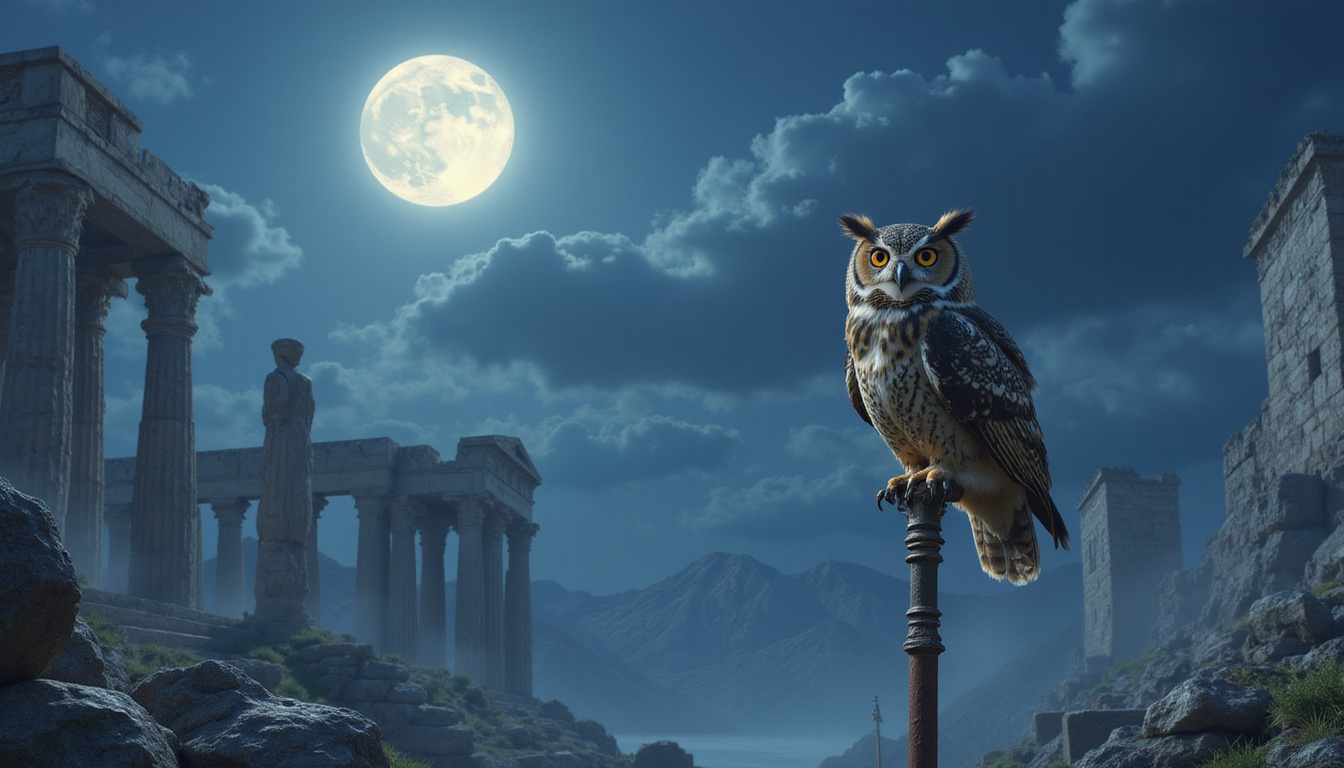
No discussion of Greek animal symbolism is complete without Athena’s owl. The little owl (Athene noctua) was so closely associated with her that its image appeared on Athenian coins.
Why the Owl for the Goddess of Wisdom?
The owl reflects several aspects of Athena:
- Sharp sight in darkness: Just as an owl sees clearly at night, Athena cuts through ignorance and confusion.
- Silent flight, sudden strike: Athena is not the brute-force kind of war god; she is strategic, tactical, and precise.
- City protection: Owls often nested in city walls and olive groves, both of which were connected to Athena as a guardian of cities and civilization.
Athena’s owl also had a practical, everyday presence:
- Athenians saw the owl as a good omen in battle.
- Coins bearing the owl circulated widely, spreading Athena’s symbolism throughout the Mediterranean (source: Perseus Digital Library).
The owl exposes Athena’s dual nature: a deity of war and wisdom who relies on insight rather than raw power.
Poseidon’s Horses and Bulls: Untamed Power and the Sea
Greek animal symbolism around Poseidon, god of the sea and earthquakes, highlights raw, elemental force.
Horses: Speed, Waves, and Earthshaking Hooves
The Greeks connected the movement of the sea to galloping horses:
- Foamy waves were imagined as white horses’ manes.
- Poseidon is said to have created the first horse, making him a patron of charioteers and horse tamers.
- As “Earth-shaker,” Poseidon’s quakes were like herds of horses thundering underground.
This symbolism shows Poseidon as the god of both wild power and mastery, since taming horses mirrored the desire to harness the sea.
Bulls: Strength, Virility, and Sacrifice
The bull was another powerful animal for Poseidon:
- Bulls were sacrificial animals, often drowned in the sea to honor him.
- Their strength and aggression reflected unpredictable surges of the ocean and seismic force.
Through horses and bulls, Poseidon appears as a god of overwhelming energy—dangerous, necessary, and barely controllable.
Artemis and the Deer: Wilderness, Purity, and the Hunt
Artemis, goddess of the hunt, wilderness, and young women, is strongly tied to the deer, especially the stag.
The Deer as a Symbol of Artemis
In Greek animal symbolism, the deer encapsulates:
- Wild freedom: Deer roam forests and mountains—Artemis’s sacred territories.
- Speed and elusiveness: Hunters must respect skill and patience, traits Artemis demands.
- Purity and vulnerability: Deer are graceful and shy, reflecting Artemis’s own commitment to chastity and protection of maidens.
Sacred stories, like that of the Ceryneian Hind that Heracles had to capture, highlight Artemis’s authority over all wild creatures. Hurting or disrespecting her animals often brought divine punishment, underscoring her fierce protective side.
Apollo and Helios: The Sun’s Horses and the Sacred Swan
Apollo and the earlier sun-god Helios share solar animal symbolism, showing how the Greeks envisioned light and music.
Solar Horses and the Chariot of the Sun
Helios is famously depicted driving a chariot drawn by fiery horses across the sky:
- These solar horses symbolize:
- Daily, reliable order (sunrise and sunset).
- Consuming light and heat.
- The endurance of cosmic cycles.
When Apollo gradually absorbed solar traits, these chariot horses were absorbed into his imagery as well, linking him with cosmic harmony and rhythm.
Swans and Musical Harmony
Apollo is also connected with the swan:
- Swans were thought to sing beautifully before death, a “swan song” linked to prophecy and awareness.
- Their grace on water parallels Apollo’s refinement in music, poetry, and healing.
The swan, through Greek animal symbolism, reveals Apollo as both bright and gentle—a deity of light, order, and art.
Ares and the Vulture: Violent War and Aftermath
While Athena represented strategic warfare, Ares embodied raw bloodshed—and his animal symbols are darker.
Vultures and Dogs: The Cost of Conflict
Vultures and war dogs following armies into battle sent a grim message:
- Vultures symbolized:
- The inevitability of death.
- The god’s delight in carnage and chaos.
- Dogs, scavenging corpses, emphasized the brutality and dishonor of uncontrolled violence.
Here, Greek animal symbolism becomes a moral commentary: war without wisdom leads to horrors that even the gods find repellent or excessive.
Hera’s Peacock and Cow: Status, Watchfulness, and Matrimony
Hera, queen of the gods and goddess of marriage, is tied to the cow and later the peacock.
Cow: Nurture and Dignity
The cow, as a Hera symbol, conveys:
- Fertility and motherhood, central to Hera’s role in legitimate births and households.
- Gentle strength and patience, idealized virtues for marriage and family structure.
Peacock: Pride and All-Seeing Eyes
In later traditions, Hera is associated with the peacock:
- The peacock’s eyes on its tail represent Hera’s watchfulness and jealousy, especially toward Zeus’s affairs.
- Its glamor and display mirror royal status and dignity.
Together, these animals highlight Hera’s dual nature: protector of lawful unions and stern punisher of betrayal.
Hybrid Creatures: What Monsters Reveal About Human Fears
Mythical hybrids are where Greek animal symbolism becomes most intense and revealing. These creatures combine human, divine, and animal qualities, exposing anxieties about boundaries and excess.
Centaurs: Half-Man, Half-Horse
Centaurs, with human torsos and horse bodies, express:
- Instinct vs. reason: They often represent unrestrained passions—drunkenness, lust, violence.
- Exceptions that reveal ideals: Chiron, the wise centaur, shows what happens when instinct is guided by intellect and virtue.
Centaurs symbolize the constant tension between civilized behavior and animal impulse.
The Minotaur: Man, Bull, and the Labyrinth
The Minotaur, born from a cursed union and shut away in the Labyrinth, combines:
- Human intelligence with
- Bestial appetite and brute bull strength.
This monster reveals fears about:
- Hidden shame and family secrets.
- The monstrous potential within human desire.
- Power structures (like King Minos’s) that try to bury problems instead of resolving them.
Chimera, Hydra, and Gorgons
Other famous monsters include:
- Chimera: Lion, goat, serpent—embodying chaotic, unnatural combination.
- Hydra: Many-headed serpent that grows stronger when attacked—symbolizing problems that multiply if mishandled.
- Gorgons (Medusa): Human-animal hybrid whose gaze turns men to stone—expressing fear of female rage or the unknown.
These creatures act as symbolic challenges for heroes. Defeating them is not just physical; it represents mastering chaos, fear, and the irrational.
Sacred Serpents: Earth, Healing, and the Underworld
Snakes hold a particularly rich place in Greek animal symbolism, appearing from temples to household altars.
Snakes as Chthonic and Healing Powers
Snakes shed their skins, suggesting:
- Renewal and rebirth, making them fitting symbols for:
- Asclepius, god of healing (his staff with a serpent remains a medical symbol today).
- Underworld deities and ancestral spirits tied to the earth.
At temples of Asclepius, sacred snakes were kept as living symbols of health and transformative power. Their connection to the ground tied them simultaneously to life, death, and rebirth.
What Greek Animal Symbolism Reveals About the Gods
When we view the pantheon through Greek animal symbolism, consistent patterns emerge:
-
Character Traits Externalized
- Zeus’s eagle = authority and vision.
- Athena’s owl = cautious intelligence.
- Ares’s vultures = unchecked brutality.
-
Domains Made Visible
- Poseidon’s horses and bulls = sea and quake power.
- Artemis’s deer = wild forests and untouched nature.
- Helios’s horses = the daily sun path.
-
Moral and Psychological Lessons
- Centaurs, Minotaur, and Chimera dramatize dangers of excess, hubris, and chaos.
- Serpents show that what seems frightening can also heal and renew.
The Greeks projected their values, fears, and hopes onto animals, using them as mirrors that reflected both gods and humans.
Quick Reference: Key Gods and Their Animals
- Zeus: Eagle, bull
- Hera: Cow, peacock
- Athena: Owl, snake
- Apollo: Swan, dolphin, raven
- Artemis: Deer, hunting dogs, bear (in some cults)
- Poseidon: Horse, bull
- Ares: Vulture, war dogs
- Dionysus: Panther, bull, serpent
- Hermes: Ram, tortoise, rooster
- Demeter: Pig, snake
- Hades: Black ram, black bulls
FAQ: Greek Animal Symbolism and Mythical Creatures
1. What is Greek animal symbolism in mythology?
Greek animal symbolism is the practice of linking specific animals to gods, heroes, and stories to express deeper meanings—such as wisdom, power, chaos, or fertility. These animals act as visual shortcuts to the character and domain of each deity, making abstract divine traits easier to grasp.
2. How do mythical creatures reflect Greek animal symbolism?
Mythical creatures like centaurs, the Minotaur, and the Chimera combine multiple animal (and sometimes human) forms. Their hybrid nature amplifies symbolic traits—lust, rage, chaos, cunning—and turns them into living puzzles for heroes to solve, showing how the Greeks understood inner conflict and the struggle to master destructive forces.
3. Which animals are most important in ancient Greek animal symbolism?
Some of the most important include the eagle (Zeus), owl (Athena), horse and bull (Poseidon), deer (Artemis), serpent (Asclepius and chthonic powers), and the cow and peacock (Hera). Each one is tied to a god’s personality, domain, and worship, giving us a detailed picture of Greek religious and cultural values.
Greek animal symbolism opens a vivid window into the ancient imagination. If you’re exploring Greek myths, religion, or even planning creative work inspired by the classics, pay close attention to the animals and monsters that appear—they are never random. To deepen your understanding, consider reading primary sources like Homer, Hesiod, and the tragedians, and then returning to these symbols with fresh eyes. Let the creatures of Greek myth guide you to a richer, more nuanced understanding of the gods—and of the human stories told about them.
Animals have inspired symbols and beliefs across cultures for centuries. Discover how these traditions connect with psychology, spirituality, and human consciousness at SpiritualMindScience.com.